
Breadcrumb

  1. Home

Endorsed with Conditions

30-Day Post-Operative Colon Surgery (COLO) and Abdominal Hysterectomy (HYST) Surgical Site Infection (SSI) Standardized Infection Ratio (SIR)

Annual risk-adjusted standardized infection ratio (SIR) of observed over predicted deep incisional primary and organ/space surgical site infections (SSIs), over a 30-day post-operative surveillance period, among hospitalized adults who are >=18 year of age with a date of admission and date of discharge that are different calendar days, and the patient underwent a colon surgery (COLO) or abdominal hysterectomy (HYST) at an acute care hospital or oncology hospital.  The 30-day postoperative surveillance period includes SSIs detected upon admission to the facility or a readmission to t

CBE ID
0753

30-Day Unplanned Readmissions for Cancer Patients

30-Day Unplanned Readmissions for Cancer Patients measure is a cancer-specific measure. It provides the rate at which adult cancer patients have an unplanned readmission within 30 days of discharge from an acute care hospital. The unplanned readmission is defined as a subsequent inpatient admission to a short-term acute care hospital, which occurs within 30 days of the discharge date of an eligible index admission and has an admission type of “emergency” or “urgent.”

CBE ID
3188

Bloodstream Infection in Hemodialysis Outpatients

Annual standardized infection ratio (SIR) of bloodstream infections (BSIs) among children and adults receiving maintenance hemodialysis at outpatient hemodialysis facilities. BSIs are defined as positive blood cultures for hemodialysis patients which are reported monthly by participating facilities. The SIR is reported for a yearly period (calendar year) and is calculated by dividing the number of observed BSIs by the number of predicted BSIs during the year.

CBE ID
1460

CAHPS® Home Health Care Survey Care of Patients

The updated Consumer Assessment of Healthcare Providers and Systems® (CAHPS) Home Health Care Survey, also referred as “HHCAHPS,” is a 25-item instrument. This is a standardized survey instrument and data collection methodology for measuring home health patients’ perspectives on their home health care in Medicare-certified home health care agencies. The survey is administered monthly to patients who recently received or are receiving home health care from Medicare-certified home health agencies. It is offered as mail-only, phone-only or mixed mode (mail with telephone follow-up).

CBE ID
0517-1

CAHPS® Home Health Care Survey Communications Between Providers and Patients

The updated Consumer Assessment of Healthcare Providers and Systems® (CAHPS) Home Health Care Survey, also referred as “HHCAHPS,” is a 25-item instrument. This is a standardized survey instrument and data collection methodology for measuring home health patients’ perspectives on their home health care in Medicare-certified home health care agencies. The survey is administered monthly to patients who recently received or are receiving home health care from Medicare-certified home health agencies. It is offered as mail-only, phone-only or mixed mode (mail with telephone follow-up).

CBE ID
0517-2

CAHPS® Home Health Care Survey Review Medicines

The updated Consumer Assessment of Healthcare Providers and Systems® (CAHPS) Home Health Care Survey, also referred as “HHCAHPS,” is a 25-item instrument. This is a standardized survey instrument and data collection methodology for measuring home health patients’ perspectives on their home health care in Medicare-certified home health care agencies. The survey is administered monthly to patients who recently received or are receiving home health care from Medicare-certified home health agencies. It is offered as mail-only, phone-only or mixed mode (mail with telephone follow-up).

CBE ID
0517-3

CAHPS® Home Health Care Survey Talk About Home Safety

The updated Consumer Assessment of Healthcare Providers and Systems® (CAHPS) Home Health Care Survey, also referred as “HHCAHPS,” is a 25-item instrument. This is a standardized survey instrument and data collection methodology for measuring home health patients’ perspectives on their home health care in Medicare-certified home health care agencies. The survey is administered monthly to patients who recently received or are receiving home health care from Medicare-certified home health agencies. It is offered as mail-only, phone-only or mixed mode (mail with telephone follow-up).

CBE ID
0517-4

CAHPS® Home Health Care Survey Talk About Medicine Side Effects

The updated Consumer Assessment of Healthcare Providers and Systems® (CAHPS) Home Health Care Survey, also referred as “HHCAHPS,” is a 25-item instrument. This is a standardized survey instrument and data collection methodology for measuring home health patients’ perspectives on their home health care in Medicare-certified home health care agencies. The survey is administered monthly to patients who recently received or are receiving home health care from Medicare-certified home health agencies. It is offered as mail-only, phone-only or mixed mode (mail with telephone follow-up).

CBE ID
0517-5

Catheter-Associated Urinary Tract Infection (CAUTI) Standardized Infection Ratio

CMS Measures Inventory Tool (CMIT) ID
00459-01-C-IRFQR
Steward Organization Group
Centers for Disease Control and Prevention
Committee
MSR Recommendation Group
    Measure Overview
      Use in CMS Programs
      CMS Program History
      • Finalized for inclusion in the Inpatient Rehabilitation Facility Quality Reporting program in 2012. 
      • Implemented in the Inpatient Rehabilitation Facility Quality Reporting program in 2014.
      • Also active in the Long-Term Care (LTC) Hospital Quality Reporting program and the PPS-Exempt Cancer Hospital Quality Reporting (PCHQR) Program. 
      Description

      Annual risk-adjusted standardized infection ratio (SIR) of catheter-associated urinary tract infections (CAUTI) among adults and children hospitalized as inpatients at acute care hospitals, critical access hospitals, oncology hospitals, long-term acute care hospitals, and acute care rehabilitation hospitals. SIR is reported annually and is calculated by dividing the number of observed CAUTIs by the number of predicted CAUTIs.   

      Numerator

      Number of annually observed catheter-associated urinary tract infections (CAUTI) in hospital inpatients.

      Numerator Exclusions

      N/A

      Numerator Exceptions

      N/A

      Denominator

      The denominator for both the SIR and the ARM is the total number of predicted CAUTI during hospitalization for patients within the unit of study (i.e., location under surveillance). The predicted number of infections for a facility is calculated based on the reported number of catheter days at the location-level using a negative binomial regression that accounts for the following risk factors:

      ACHs: CDC-defined location within a facility (e.g., critical ICUs, SCAs, step-down units, etc.), bed size, medical school affiliation, and facility type

      CAHs: medical school affiliation

      IRFs: setting type, proportion of admissions with traumatic and non-traumatic spinal cord dysfunction, proportion of admissions with stroke

      LTACHs: average length of stay, setting type, and location type.

      Denominator Exclusions

      The following are not considered indwelling catheters by NHSN definitions:

      • Suprapubic catheters
      • Condom catheters
      • “In and out” catheterizations
      • Nephrostomy tubes
      • Ileoconduits 
      Denominator Exceptions

      N/A

      Cascade of Meaningful Measures Priority
      Measure Type
      Outcome
      Level of Analysis
      Facility
      Care Setting
      Hospital: Inpatient Acute Care Facility
      PPS-Exempt Cancer Hospital
      Inpatient Rehabilitation Facility
      Long-Term Acute Care Facility
      CBE Endorsement Status
      Endorsed with Conditions
      CBE Endorsement History

      Endorsement History: 

      • Initial endorsement, 2012.
      • New measure endorsed with conditions Spring 2025.

      Link to Endorsement Measure Record: National Healthcare Safety Network (NHSN) Catheter-Associated Urinary Tract Infection (CAUTI) Outcome Measure

        About this Analysis (Measure Score by PY)

        Impact Summary: This measure supports the Inpatient Rehabilitation Facility Quality Reporting Program by assessing health care-associated catheter-associated urinary tract infections (CAUTI) among patients in bedded inpatient rehabilitation facilities, an outcome directly associated with patient safety and quality of care. 

        Based on the most recent data, the total estimated number of CAUTIs across all deciles is approximately 1,400. If inpatient rehabilitation facilities with higher CAUTI rates improved their performance to levels observed among better-performing facilities, the analysis suggests that up to about 1,400 CAUTIs could potentially be avoided, indicating a substantial opportunity for improved patient outcomes.

        For this measure, Battelle reviewed the following publicly available datasets available at Inpatient Rehabilitation Facility - Provider Data | Provider Data Catalog (cms.gov):

        • Inpatient_rehabilitation_facilities_03_2026.zip (which contains data from April 2024-March 2025 and is referred to as year 2024 in this assessment)
        • Inpatient_rehabilitation_facilities_03_2025.zip (which contains data from April 2023-March 2024 and is referred to as year 2023 in this assessment)
        • Inpatient_rehabilitation_facilities_03_2024.zip (which contains data from April 2022-March 2023 and is referred to as year 2022 in this assessment)
        • Inpatient_rehabilitation_facilities_03_2023.zip (which contains data from April 2021-March 2022 and is referred to as year 2021 in this assessment)

        Battelle analyzed all values for “I_006_01” not marked as “Not Available” from the corresponding Inpatient_Rehabilitation_Facility-Provider_Data.csv file.


        About Figure 1: Figure 1 is a boxplot that shows how scores have changed based on the most recent 4 years of data available. For each year, the boxplot displays a box with lines and dots to help visualize the range and distribution of scores. The dots represent the points where the lowest 5% and highest 5% of scores fall, and the line connecting them shows where 90% of the scores are located. The box itself covers the middle half of the scores, from the 25th to the 75th percentile. Inside the box, a horizontal line marks the median score, which is the middle value, while a “+” sign shows the average score. This type of graph makes overall trends in scores over time as well as the consistency and spread of the results easier to understand.

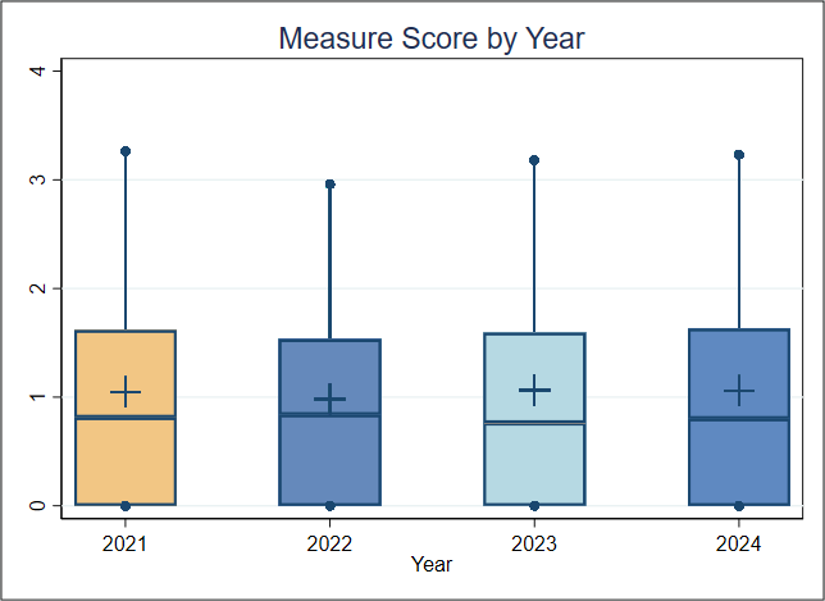
        Figure 1 (Measure Score by PY)
        boxplot


        Figure 1. Boxplot of Measure Score by Year

        Interpretation (Measure Score by PY)

        Figure 1 Interpretation: There is no discernible change across the 4 years. For this measure, a lower score indicates better quality of care.

        About this Analysis (Score Distro)

        About Table 1: Table 1 illustrates the distribution of scores and the number of patients represented within each group. It is important to note that the groups (referred to as deciles, each comprising 10% of the organizations) with the lowest or highest scores may contain more or fewer patients than other groups. For example, if the lowest-scoring decile includes only 5% of the total patient population, this smaller group size may be associated with lower performance scores.

        Table 1 (Score Distro)

        Table 1. Importance in the Most Recent Year of Data Available (Decile by Measure Score, FY2024) 

         OverallDecile 1Decile 2Decile 3Decile 4Decile 5Decile 6Decile 7Decile 8Decile 9Decile 10
        Average SIR (Standard Deviation)

        1.060 (1.089)

        0

        0

        0

        0

        0.117

        0.688

        1.142

        1.706

        2.326

        3.562

        Average Raw Rate (Standard Deviation)

        0.200 (0.328)

        0

        0

        0

        0

        0.006

        0.099

        0.194

        0.291

        0.450

        0.957

        Entities

        1,123

        113

        112

        112

        113

        112

        112

        113

        112

        112

        112

        Patients

        790,630

        50,594

        48,918

        58,134

        49,690

        77,282

        167,930

        116,230

        100,352

        82,073

        39,427

        Interpretation (Score Distro)

        Table 1 Interpretation: To estimate the number of negative outcomes (CAUTIs), the number of patients is multiplied by the average raw rate for each decile. Right now, the total estimated number of negative outcomes across all deciles is about 1,400. If the average performance of Decile 3 (0%) is considered a plausible, achievable score, and the entities in Deciles 4 through 10 improved to reach that score, about 1,400 fewer measured patients would contract CAUTIs. This translates to about one patient per entity.

          Importance Criterion Definition

          The Meaningfulness criterion will be evaluated as part of the full Preliminary Assessment available in September. 

            Criterion Definition

            This criterion will be evaluated as part of the full Preliminary Assessment available in September. 

              Criterion Definition

              This criterion will be evaluated as part of the full Preliminary Assessment available in September. 

              PA Type
              Performance and Impact Analysis (PIA)