
Breadcrumb

  1. Home

Safety

30-Day Post-Operative Colon Surgery (COLO) and Abdominal Hysterectomy (HYST) Surgical Site Infection (SSI) Standardized Infection Ratio (SIR)

CMS Measures Inventory Tool (CMIT) ID
00001-02-C-PCHQR
Steward Organization Group
Centers for Disease Control and Prevention
Committee
MSR Recommendation Group
    Measure Overview
      Use in CMS Programs
      CMS Program History
      • Finalized for inclusion in the PCHQR Program in 2013.
      • Implemented in the PCHQR Program in 2014. 
      Description

      Annual risk-adjusted standardized infection ratio (SIR) of observed over predicted deep incisional primary and organ/space surgical site infections (SSIs), over a 30-day post-operative surveillance period, among hospitalized adults who are >=18 year of age with a date of admission and date of discharge that are different calendar days, and the patient underwent a colon surgery (COLO) or abdominal hysterectomy (HYST) at an acute care hospital or oncology hospital.  The 30-day postoperative surveillance period includes SSIs detected upon admission to the facility or a readmission to the same facility or a different facility (other than where the procedure was performed) and via post-discharge surveillance.

      Numerator

      Number of annually observed hospitalized patients who are >=18 years of age with a date of admission and date of discharge that are different calendar days, and the patient underwent a colon surgery (COLO) or abdominal hysterectomy (HYST) and developed a deep incisional primary or organ/space surgical site infection (SSI) within the 30-day postoperative surveillance period.  The 30-day postoperative surveillance period includes SSIs detected upon admission to the facility or a readmission to the same facility or a different facility (other than where the procedure was performed) and via post-discharge surveillance.

      Numerator Exclusions

      N/A

      Numerator Exceptions

      N/A

      Denominator

      Number of annually predicted hospitalized patients who are >=18 years of age with a date of admission and date of discharge are different calendar days, and the patient underwent a colon surgery (COLO) or abdominal hysterectomy (HYST)  and developed a deep incisional primary or organ/space surgical site infection (SSI) within the 30-day post-operative surveillance period. The 30-day postoperative surveillance period includes SSIs detected upon admission to the facility or a readmission to the same facility or a different facility (other than where the procedure was performed) and via post-discharge surveillance.

      Denominator Exclusions
      • Procedures that develop a postoperative surgical site infection (SSI) and the infection is present at the time of surgery (PATOS), the SSI event and surgical procedure are excluded  
      • ASA class VI 
      • Patients whose admission date and discharge date are the same day.  
      • Patients <18 years of age 
      • Patients >= 109 years of age 
      • Adult patients, >=18 years of age, BMI is less than 12 or greater than 60 
      • Procedures reported in patients with sex reported as Other are excluded from the SSI SIR  
      • Surgical procedure duration less than 5 minutes or exceeding the IQR5 value 
      Denominator Exceptions

      N/A

      Cascade of Meaningful Measures Priority
      Measure Type
      Outcome
      Level of Analysis
      Facility
      Care Setting
      PPS-Exempt Cancer Hospital
      Hospital: Inpatient
      Hospital: Outpatient
      CBE Endorsement Status
      Endorsed
      CBE Endorsement History

      Endorsement History: Endorsed with conditions in 2012 and endorsement retained during maintenance review in 2025. 

      Link to Endorsement Measure Record: 30-Day Post-Operative Colon Surgery (COLO) and Abdominal Hysterectomy (HYST) Surgical Site Infection (SSI) Standardized Infection Ratio (SIR)

        About this Analysis (Measure Score by PY)

        Impact Summary: This measure supports the PCHQR Program’s objectives by providing transparent, standardized infection ratio data that empowers consumers to make informed health care decisions and motivates hospitals and clinicians to focus on quality improvement and adherence to best practices in inpatient care for Medicare beneficiaries. 

        Analysis of measure performance over the past 4 years is impacted by the small number of PCHQR hospitals available to report on this measure, rather than low participation among a large eligible group. 

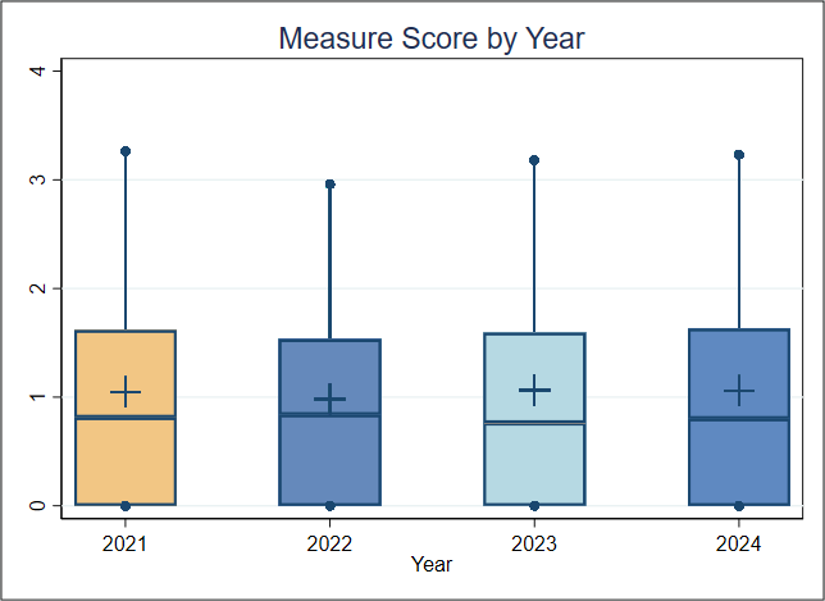
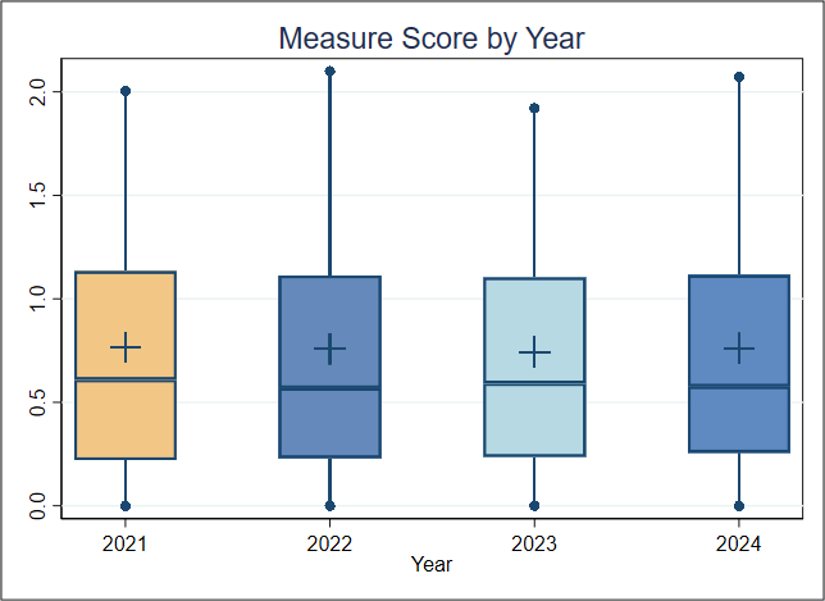
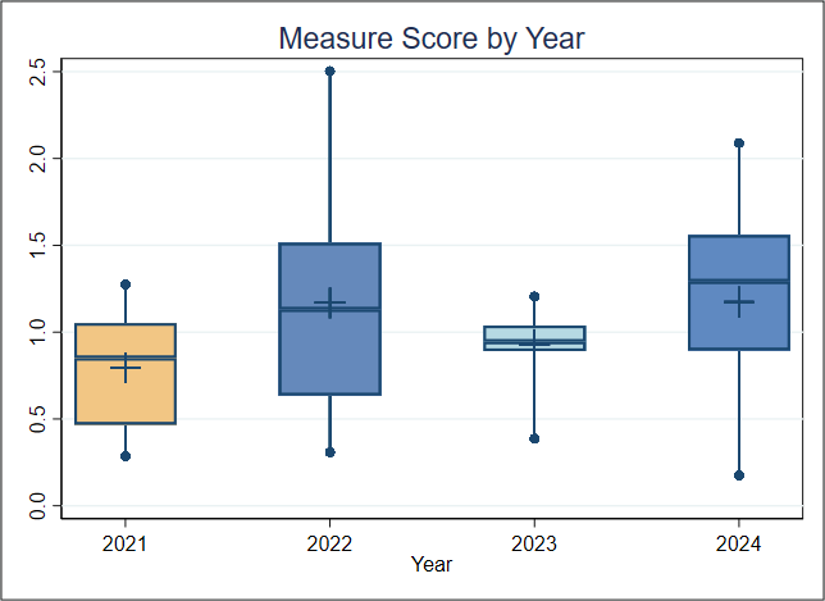
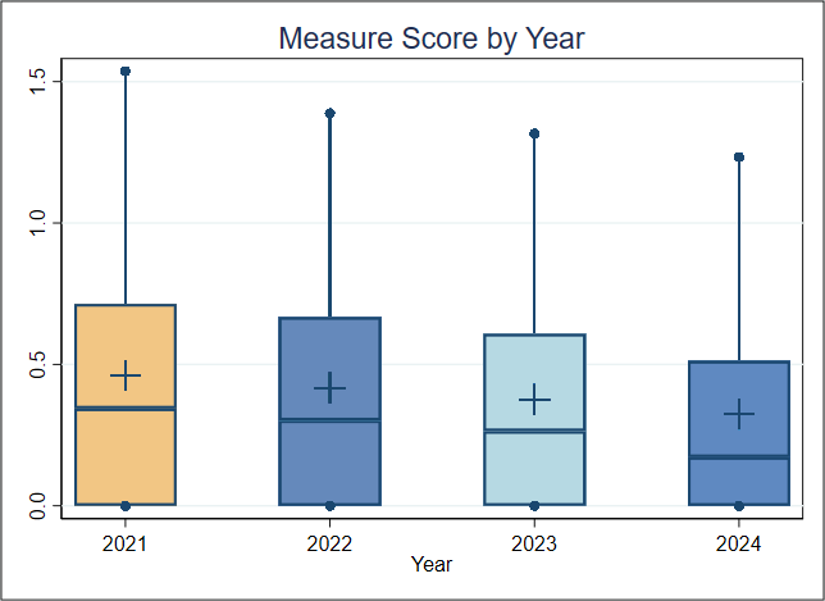
        With only seven entities per year in Figure 1a and eight in Figure 1b, distinguishing true trends from random variation is difficult, and little discernable change is observed across the 4 years. Tables 1a and 1b demonstrate potential improvements that translate to a reduction in surgical site infections of fewer than three eligible patients per entity.

        For this measure, Battelle reviewed the following publicly available datasets available at Hospitals data archive | Provider Data Catalog:

        • Hospitals_02_2026.zip (which contains data from April 2024-March 2025 and is referred to as year 2024 in this assessment)
        • Hospitals_02_2025.zip (which contains data from April 2023-March 2024 and is referred to as year 2023 in this assessment)
        • Hospitals_01_2024.zip (which contains data from April 2022-March 2023 and is referred to as year 2022 in this assessment)
        • Hospitals_01_2023.zip (which contains data from April 2021-March 2022 and is referred to as year 2021 in this assessment)

        Battelle analyzed all values for “PCH_6” and “PCH_7” not marked as “Not Available” from the corresponding PCH_HEALTHCARE_ASSOCIATED_INFECTIONS_HOSPITAL.csv file.


        About Figure 1a and 1b: Figures 1a and 1b are boxplots that show how scores have changed based on the most recent 4 years of data available. For each year, the boxplot displays a box with lines and dots to help visualize the range and distribution of scores. The dots represent the points where the lowest 5% and highest 5% of scores fall, and the line connecting them shows where 90% of the scores are located. The box itself covers the middle half of the scores, from the 25th to the 75th percentile. Inside the box, a horizontal line marks the median score, which is the middle value, while a “+” sign shows the average score. This type of graph makes overall trends in scores over time as well as the consistency and spread of the results easier to understand.
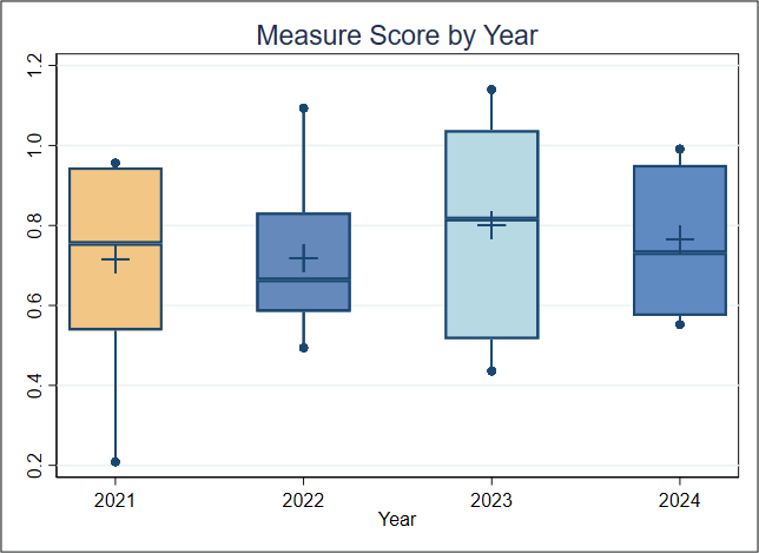
        Figure 1 (Measure Score by PY)
        boxplot

        Figure 1a. Boxplot of Measure Score by Year (Colon Surgery)
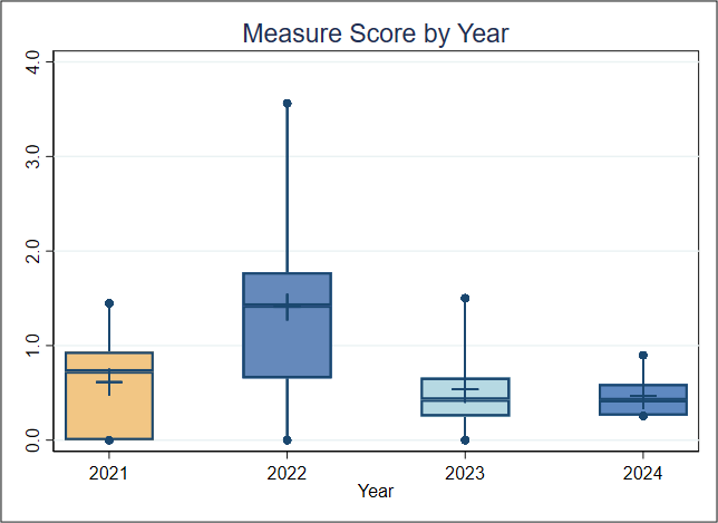
         

        Figure 1b. Boxplot of Measure Score by Year (Abdominal Hysterectomy)

        Interpretation (Measure Score by PY)

        Figure 1a and 1b Interpretation: In Figure 1a, each year includes data from only seven entities, while Figure 1b includes eight entities per year. Because of this small sample size, any trends observed over the 4 years could be due to random variation rather than meaningful change. Overall, the limited number of PPS-exempt cancer hospitals participating and reporting in this program makes analyzing overall performance trends difficult. For this measure, lower scores reflect higher quality of care.

        About this Analysis (Score Distro)

        About Table 1a and 1b: Tables 1a and 1b illustrate the distribution of scores (SIRs), raw rates, and the number of patients represented within each entity. It is important to note that the entities with the lowest or highest scores may contain more or fewer patients than other entities. For example, if the lowest-scoring entity includes only 5% of the total patient population, then smaller entity size may be associated with lower performance scores.

        Table 1 (Score Distro)

        Table 1a. Importance (Entity by Measure Score, FY2024) Colon Surgery in the Most Recent Year of Data Available

         OverallEntity 1Entity 2Entity 3Entity 4Entity 5Entity 6Entity 7
        Average SIR (Standard Deviation)0.764 (0.184)0.5740.5520.6440.7320.9070.9510.991
        Average Raw Rate (Standard Deviation) 3.55 (0.82)2.682.683.083.214.224.474.50
        Entities71111111
        Patients3,8404867844554672841,164200


        Table 1b. Importance (Entity by Measure Score, FY2024) Abdominal Hysterectomy in the Most Recent Year of Data Available

         OverallEntity 1Entity 2Entity 3Entity 4Entity 5Entity 6Entity 7Entity 8
        Average SIR (Standard Deviation)0.471 (0.231)N/A0.2570.2600.3180.4230.5930.5470.898
        Average Raw Rate (Standard Deviation) 0.599 (0.388)00.3760.3880.4460.6310.8260.8401.283
        Entities811111111
        Patients2,56132662582243172422381,013


        Interpretation (Score Distro)

        Table 1a and Table 1b Interpretation: Note that there are data for only seven entities for Table 1a and eight entities for Table 1b. To estimate the number of negative outcomes (surgical site infections), the number of patients is multiplied by the average raw rate for each entity. 


        The total estimated number of negative outcomes across all entities for Table 1a is about 140. If the average performance of the lowest two entities (2.68%) is considered a plausible, achievable rate, and the other five entities improved to reach that rate, about 30 fewer colon surgery patients would experience surgical site infections. This translates to about four patients per entity and could mean that improving performance on this measure could help ensure that fewer colon surgery patients would contract surgical site infections, potentially leading to better health outcomes. 


        The total estimated number of negative outcomes (surgical site infections) across all entities for Table 1b is about 22. If all entities reduced the rate to 0%, 22 fewer abdominal hysterectomy patients would experience surgical site infections. This translates to less than three eligible patients per entity. 

          Importance Criterion Definition

          The Meaningfulness criterion will be evaluated as part of the full Preliminary Assessment available in September. 

            Criterion Definition

            This criterion will be evaluated as part of the full Preliminary Assessment available in September. 
              Criterion Definition

              This criterion will be evaluated as part of the full Preliminary Assessment available in September. 
              Enter a comment below

              One file only.
              256 MB limit.
              Allowed types: pdf png jpg gif svg docx.
              Solve this simple math problem and enter the result. E.g. for 1+3, enter 4.
              This question tests whether or not you are a human visitor to prevent automated spam submissions.
              PA Type
              Performance and Impact Analysis (PIA)

              Adult Primary Rhegmatogenous Retinal Detachment Surgery: No Return to the Operating Room Within 90 Days of Surgery

              CMS Measures Inventory Tool (CMIT) ID
              00031-01-C-MIPS
              Steward Organization Group
              American Academy of Ophthalmology
              Committee
              MSR Recommendation Group
                Measure Overview
                  Use in CMS Programs
                  CMS Program History
                  • Finalized through rulemaking for inclusion in the Merit-based Incentive Payment System (MIPS) in 2016. 
                  • Implemented in MIPS starting with Performance Year (PY) 2017. 
                  Description

                  Patients aged 18 years and older who had surgery for primary rhegmatogenous retinal detachment who did not require a return to the operating room within 90 days of surgery.

                  Numerator

                  Patients who did not return to the operating room within 90 days for complications within the operative eye.

                  Numerator Exclusions

                  N/A

                  Numerator Exceptions

                  N/A

                  Denominator

                  Patients aged 18 years or older who had surgery for primary rhegmatogenous retinal detachment.

                  Denominator Exclusions

                  Surgical procedures that included the use of silicone oil.

                  Denominator Exceptions

                  N/A

                  Cascade of Meaningful Measures Priority
                  Measure Type
                  Outcome
                  Level of Analysis
                  Clinician: Group/Practice
                  Clinician: Individual
                  Care Setting
                  Ambulatory Care: Clinician Office
                  CBE Endorsement Status
                  Not Endorsed
                  CBE Endorsement History

                  N/A

                    About this Analysis (Measure Score by PY)

                    Impact Summary: This measure supports the Merit‑based Incentive Payment System by assessing short‑term surgical outcomes for adults undergoing primary rhegmatogenous retinal detachment surgery, specifically the absence of a return to the operating room within 90 days of the initial procedure. 

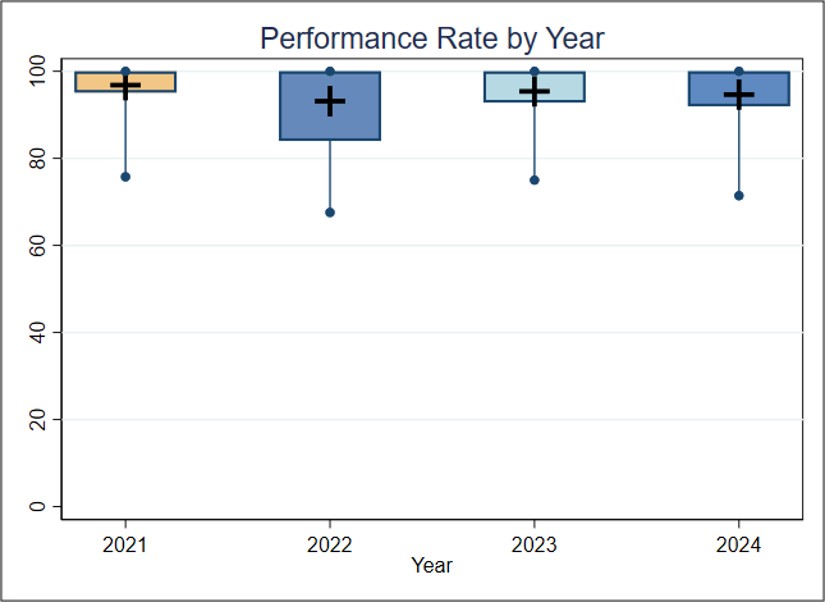
                    Performance on this measure is consistently high, with most clinicians achieving rates above 90% and a substantial proportion achieving 100%. 

                    Based on the most recent benchmark data, if clinicians in Deciles 1 through 7 improved to the average performance observed in Decile 8 (100%), the percentage of patients with no return to the operating room within 90 days of surgery could increase by about 5 percentage points, from 94.7% to nearly 100%, potentially improving patient outcomes.

                    For this measure, Battelle reviewed the following publicly available datasets at Benchmarks - QPP:

                    • 2026 MIPS Quality Benchmarks.csv (referred to as year 2024 in this assessment)
                    • 2025 MIPS Quality Benchmarks.csv (referred to as year 2023 in this assessment)
                    • 2024 MIPS Quality Benchmarks.csv (referred to as year 2022 in this assessment)
                    • 2023 MIPS Quality Benchmarks.csv (referred to as year 2021 in this assessment)

                    Battelle analyzed benchmark values for “Measure_ID”=384.


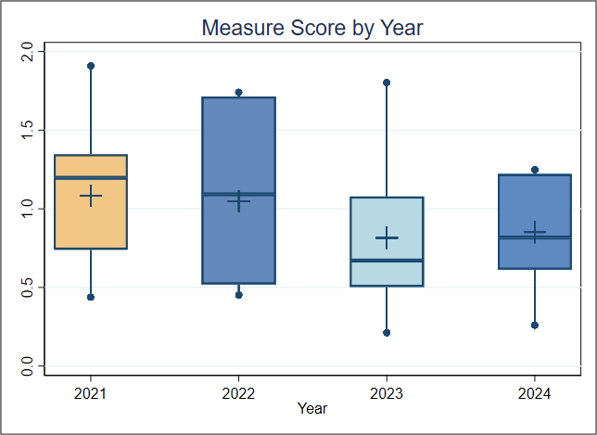
                    About Figure 1: Figure 1 is a boxplot that shows how rates have changed based on the most recent 4 years of data available. For each year, the boxplot displays a box with lines and dots to help visualize the range and distribution of rates. The dots represent the minimum and maximum rates, and the line connecting them shows the range of the rates. The box itself covers the middle 60% of the rates, from the 20th to the 80th percentile. A “+” sign shows the average rate. This type of graph makes overall trends in rates over time as well as the consistency and spread of the results easier to visualize.

                    Figure 1 (Measure Score by PY)
                    boxplot

                    Figure 1. Boxplot of Performance Rate by Year

                    Interpretation (Measure Score by PY)

                    Figure 1 Interpretation: For each of the 4 years, at least 20% of clinicians have a 100% performance rate and, except for 2022, at least 80% of the clinicians have a performance rate greater than 90%. For this measure, a higher performance rate indicates better quality of care. 


                    About this Analysis (Score Distro)

                    About Table 1: Table 1 illustrates the distribution of rates across deciles in the most recent data available. 

                    Table 1 (Score Distro)

                    Table 1. Importance (Decile by Performance Rate, FY2024)

                     MeanDecile 1Decile 2Decile 3Decile 4Decile 5Decile 6Decile 7Decile 8Decile 9Decile 10
                    Rate94.771.4-87.187.1-91.992.0-93.393.3-94.794.7-96.796.7-97.197.1-100100100100
                    Interpretation (Score Distro)

                    Table 1 Interpretation: Nearly all clinicians have a rate greater than 80%, more than 80% of clinicians have a rate greater than 90%, and more than 30% of the clinicians have a performance rate of 100%. If the average performance of Decile 8 (100%) is considered a plausible, achievable rate, and the clinicians in Deciles 1 through 7 improved to reach that rate, the estimated percentage of patients with no return to the operating room within 90 days of surgery would go up by about 5% (from 94.7% to nearly 100%), potentially leading to better health outcomes for these patients.

                      Importance Criterion Definition

                      The Meaningfulness criterion will be evaluated as part of the full Preliminary Assessment available in September.  

                        Criterion Definition

                        This criterion will be evaluated as part of the full Preliminary Assessment available in September.  
                          Criterion Definition

                          This criterion will be evaluated as part of the full Preliminary Assessment available in September.  
                          Enter a comment below

                          One file only.
                          256 MB limit.
                          Allowed types: pdf png jpg gif svg docx.
                          Solve this simple math problem and enter the result. E.g. for 1+3, enter 4.
                          This question tests whether or not you are a human visitor to prevent automated spam submissions.
                          PA Type
                          Performance and Impact Analysis (PIA)

                          Appropriate Assessment of Retrievable Inferior Vena Cava (IVC) Filters for Removal

                          CMS Measures Inventory Tool (CMIT) ID
                          00068-01-C-MIPS
                          Steward Organization Group
                          Society of Interventional Radiology
                          Committee
                          MSR Recommendation Group
                            Measure Overview
                              Use in CMS Programs
                              CMS Program History
                              • Finalized through rulemaking for inclusion in the Merit-based Incentive Payment System (MIPS) in 2016. 
                              • Implemented in MIPS starting with Performance Year (PY) 2017.
                              Description

                              Percentage of patients in whom a retrievable IVC filter is placed who, within 3 months post-placement, have a documented assessment for the appropriateness of continued filtration, device removal or the inability to contact the patient with at least two attempts.

                              Numerator

                              Number of patients that have appropriate IVC filter follow-up.

                              Numerator Exclusions

                              N/A

                              Numerator Exceptions

                              N/A

                              Denominator

                              All patients who have a retrievable IVC filter placed with the intent for potential removal at time of placement.

                              Denominator Exclusions

                              None

                              Denominator Exceptions

                              N/A

                              Cascade of Meaningful Measures Priority
                              Measure Type
                              Process
                              Level of Analysis
                              Clinician: Group/Practice
                              Clinician: Individual
                              Care Setting
                              Ambulatory Surgery Center
                              Hospital: Outpatient
                              CBE Endorsement Status
                              Not Endorsed
                              CBE Endorsement History

                              N/A

                                About this Analysis (Measure Score by PY)

                                Impact Summary: This measure supports the Merit‑based Incentive Payment System (MIPS) by promoting appropriate follow‑up assessment for patients who receive retrievable inferior vena cava (IVC) filters, a process intended to support safe device management and timely removal when clinically appropriate. 

                                Due to low reporting on this measure, no benchmark data are currently available in the publicly reported MIPS Quality Benchmarks files reviewed for this assessment. As a result, performance trends and the potential impact of improvement on patient outcomes cannot be evaluated at this time. The absence of benchmark data limits the ability to assess the importance or impact of this measure within MIPS. The measure is included in the Interventional Radiology MIPS Value Pathway (MVP), which may help increase adoption and reporting in the future.

                                For this measure, Battelle reviewed the following publicly available datasets at Benchmarks - QPP:

                                • 2026 MIPS Quality Benchmarks.csv 
                                • 2025 MIPS Quality Benchmarks.csv 
                                • 2024 MIPS Quality Benchmarks.csv 
                                • 2023 MIPS Quality Benchmarks.csv

                                There are no benchmark values for “Measure_ID”=421 in these files, and therefore no data are available to assess this measure. During these years, CMS did not receive sufficient data submissions to establish a performance period benchmark.

                                  Importance Criterion Definition

                                  The Meaningfulness criterion will be evaluated as part of the full Preliminary Assessment available in September.  
                                    Criterion Definition

                                    This criterion will be evaluated as part of the full Preliminary Assessment available in September. 
                                      Criterion Definition

                                      This criterion will be evaluated as part of the full Preliminary Assessment available in September. 
                                      Enter a comment below

                                      One file only.
                                      256 MB limit.
                                      Allowed types: pdf png jpg gif svg docx.
                                      Solve this simple math problem and enter the result. E.g. for 1+3, enter 4.
                                      This question tests whether or not you are a human visitor to prevent automated spam submissions.

                                      Barrett’s Esophagus

                                      CMS Measures Inventory Tool (CMIT) ID
                                      00087-01-C-MIPS
                                      Steward Organization Group
                                      College of American Pathologists
                                      Committee
                                      MSR Recommendation Group
                                        Measure Overview
                                          Use in CMS Programs
                                          CMS Program History
                                          • Finalized through rulemaking for inclusion in the Merit-based Incentive Payment System (MIPS) in 2016. 
                                          • Implemented in MIPS starting with Performance Year (PY) 2017. 
                                          Description

                                          Percentage of esophageal biopsy reports that document the presence of Barrett’s mucosa that also include a statement about dysplasia.

                                          Numerator

                                          Esophageal biopsy report documents the presence of Barrett’s mucosa and includes a statement about dysplasia.

                                          Numerator Exclusions

                                          N/A

                                          Numerator Exceptions

                                          N/A

                                          Denominator

                                          All surgical pathology esophageal biopsy reports for Barrett’s Esophagus.

                                          Denominator Exclusions

                                          None. 

                                          Denominator Exceptions

                                          N/A

                                          Cascade of Meaningful Measures Priority
                                          Measure Type
                                          Process
                                          Level of Analysis
                                          Clinician: Group/Practice
                                          Clinician: Individual
                                          Care Setting
                                          Hospital: Outpatient
                                          Laboratory
                                          CBE Endorsement Status
                                          Not Endorsed
                                          CBE Endorsement History

                                          N/A

                                            About this Analysis (Measure Score by PY)

                                            Impact Summary: This measure evaluates documentation quality for esophageal biopsy reports in the Merit‑based Incentive Payment System (MIPS) by assessing whether reports that identify Barrett’s mucosa also include a statement regarding dysplasia. As a process measure, it supports MIPS goals by encouraging complete and standardized pathology reporting, which contributes to accurate diagnosis and informed clinical management. This measure is subject to the 7-point Cap Removal Benchmark and represents one of the few measures applicable for pathologists within the MIPS set. 

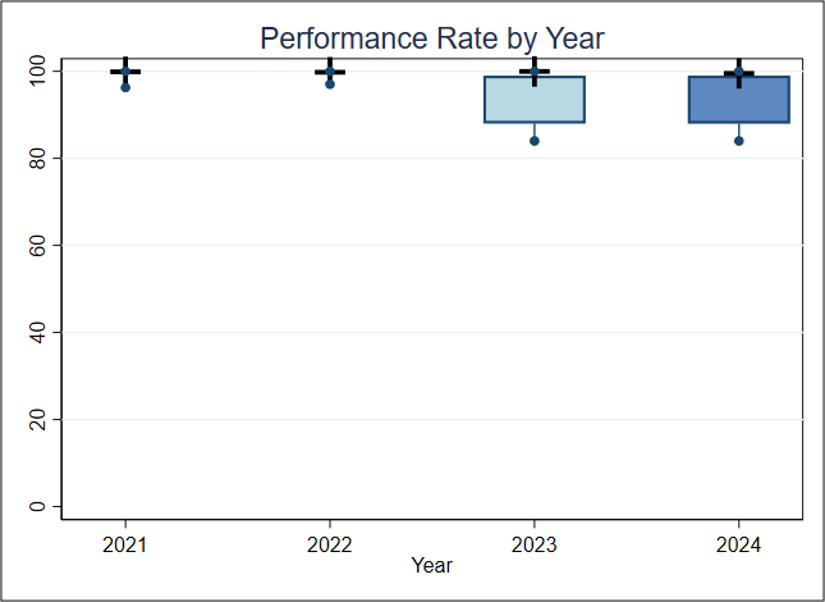
                                            Performance has been uniformly high since implementation, with benchmark data indicating that in 2021 and 2022 all reporting clinicians achieved rates greater than 95%. In 2023 and 2024, mean performance remained high, while the distribution of performance rates has widened, with a subset of clinicians reporting rates below 90%. 

                                            For this measure, Battelle reviewed the following publicly available datasets at Benchmarks - QPP:

                                            • 2026 MIPS Quality Benchmarks.csv (referred to as year 2024 in this assessment)
                                            • 2025 MIPS Quality Benchmarks.csv (referred to as year 2023 in this assessment)
                                            • 2024 MIPS Quality Benchmarks.csv (referred to as year 2022 in this assessment)
                                            • 2023 MIPS Quality Benchmarks.csv (referred to as year 2021 in this assessment)

                                            Battelle analyzed benchmark values for “Measure_ID”=249 and “Collection Type”= MIPS CQM.


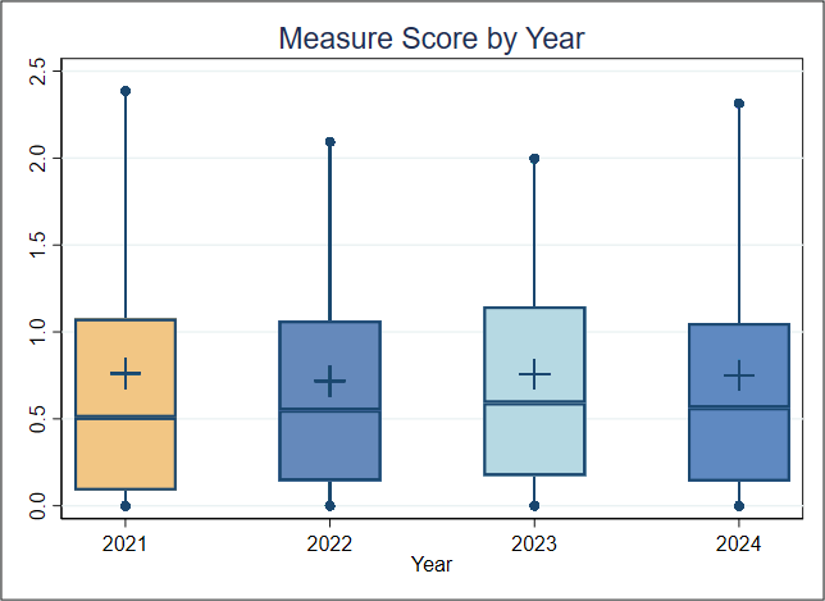
                                            About Figure 1: Figure 1 is a boxplot that shows how rates have changed based on the most recent 4 years of data available. For each year, the boxplot displays a box with lines and dots to help visualize the range and distribution of rates. The dots represent the minimum and maximum rates, and the line connecting them shows the range of the rates. The box itself covers the middle 60% of the rates, from the 20th to the 80th percentile. A “+” sign shows the average rate. This type of graph makes overall trends in rates over time as well as the consistency and spread of the results easier to visualize.

                                            Figure 1 (Measure Score by PY)
                                            boxplot

                                            Figure 1. Boxplot of Performance Rate by Year

                                            Interpretation (Measure Score by PY)

                                            Figure 1 Interpretation: In 2021 and 2022, all clinicians had a rate higher than 95%; however, in 2023 and 2024, more than 20% of clinicians had a rate less than 90%. Based on information within the benchmark files, it is not possible to determine if this decrease is due to greater variation from more clinicians reporting on the measure in later years or if rates decreased over time within the same clinician population. For this measure, a higher rate indicates better quality of care. 


                                            About this Analysis (Score Distro)

                                            About Table 1: Table 1 illustrates the distribution of rates across deciles in the most recent year of data available.

                                            Table 1 (Score Distro)

                                            Table 1. Importance (Decile by Performance Rate, FY2024) 


                                            Mean

                                            Decile 1

                                            Decile 2

                                            Decile 3

                                            Decile 4

                                            Decile 5

                                            Decile 6

                                            Decile 7

                                            Decile 8

                                            Decile 9

                                            Decile 10

                                            Rate99.584.0-86.086.0-88.088.0-90.090.0-92.092.0-94.094.0-96.096.0-98.098.0-99.099.0-100100
                                            Interpretation (Score Distro)

                                            Table 1 Interpretation: Nearly all clinicians have a performance rate greater than 85%, more than 70% of clinicians have a performance rate greater than 90%, and more than 10% of the clinicians have a performance rate of 100%.

                                              Importance Criterion Definition

                                              The Meaningfulness criterion will be evaluated as part of the full Preliminary Assessment available in September. 
                                                Criterion Definition

                                                This criterion will be evaluated as part of the full Preliminary Assessment available in September. 

                                                  Criterion Definition

                                                  This criterion will be evaluated as part of the full Preliminary Assessment available in September. 

                                                  Enter a comment below

                                                  One file only.
                                                  256 MB limit.
                                                  Allowed types: pdf png jpg gif svg docx.
                                                  Solve this simple math problem and enter the result. E.g. for 1+3, enter 4.
                                                  This question tests whether or not you are a human visitor to prevent automated spam submissions.
                                                  PA Type
                                                  Performance and Impact Analysis (PIA)

                                                  Catheter-Associated Urinary Tract Infection (CAUTI) Standardized Infection Ratio

                                                  CMS Measures Inventory Tool (CMIT) ID
                                                  00459-01-C-IRFQR
                                                  Steward Organization Group
                                                  Centers for Disease Control and Prevention
                                                  Committee
                                                  MSR Recommendation Group
                                                    Measure Overview
                                                      Use in CMS Programs
                                                      CMS Program History
                                                      • Finalized for inclusion in the Inpatient Rehabilitation Facility Quality Reporting program in 2012. 
                                                      • Implemented in the Inpatient Rehabilitation Facility Quality Reporting program in 2014.
                                                      • Also active in the Long-Term Care (LTC) Hospital Quality Reporting program and the PPS-Exempt Cancer Hospital Quality Reporting (PCHQR) Program. 
                                                      Description

                                                      Annual risk-adjusted standardized infection ratio (SIR) of catheter-associated urinary tract infections (CAUTI) among adults and children hospitalized as inpatients at acute care hospitals, critical access hospitals, oncology hospitals, long-term acute care hospitals, and acute care rehabilitation hospitals. SIR is reported annually and is calculated by dividing the number of observed CAUTIs by the number of predicted CAUTIs.   

                                                      Numerator

                                                      Number of annually observed catheter-associated urinary tract infections (CAUTI) in hospital inpatients.

                                                      Numerator Exclusions

                                                      N/A

                                                      Numerator Exceptions

                                                      N/A

                                                      Denominator

                                                      The denominator for both the SIR and the ARM is the total number of predicted CAUTI during hospitalization for patients within the unit of study (i.e., location under surveillance). The predicted number of infections for a facility is calculated based on the reported number of catheter days at the location-level using a negative binomial regression that accounts for the following risk factors:

                                                      ACHs: CDC-defined location within a facility (e.g., critical ICUs, SCAs, step-down units, etc.), bed size, medical school affiliation, and facility type

                                                      CAHs: medical school affiliation

                                                      IRFs: setting type, proportion of admissions with traumatic and non-traumatic spinal cord dysfunction, proportion of admissions with stroke

                                                      LTACHs: average length of stay, setting type, and location type.

                                                      Denominator Exclusions

                                                      The following are not considered indwelling catheters by NHSN definitions:

                                                      • Suprapubic catheters
                                                      • Condom catheters
                                                      • “In and out” catheterizations
                                                      • Nephrostomy tubes
                                                      • Ileoconduits 
                                                      Denominator Exceptions

                                                      N/A

                                                      Cascade of Meaningful Measures Priority
                                                      Measure Type
                                                      Outcome
                                                      Level of Analysis
                                                      Facility
                                                      Care Setting
                                                      Hospital: Inpatient Acute Care Facility
                                                      PPS-Exempt Cancer Hospital
                                                      Inpatient Rehabilitation Facility
                                                      Long-Term Acute Care Facility
                                                      CBE Endorsement Status
                                                      Endorsed with Conditions
                                                      CBE Endorsement History

                                                      Endorsement History: 

                                                      • Initial endorsement, 2012.
                                                      • New measure endorsed with conditions Spring 2025.

                                                      Link to Endorsement Measure Record: National Healthcare Safety Network (NHSN) Catheter-Associated Urinary Tract Infection (CAUTI) Outcome Measure

                                                        About this Analysis (Measure Score by PY)

                                                        Impact Summary: This measure supports the Inpatient Rehabilitation Facility Quality Reporting Program by assessing health care-associated catheter-associated urinary tract infections (CAUTI) among patients in bedded inpatient rehabilitation facilities, an outcome directly associated with patient safety and quality of care. 

                                                        Based on the most recent data, the total estimated number of CAUTIs across all deciles is approximately 1,400. If inpatient rehabilitation facilities with higher CAUTI rates improved their performance to levels observed among better-performing facilities, the analysis suggests that up to about 1,400 CAUTIs could potentially be avoided, indicating a substantial opportunity for improved patient outcomes.

                                                        For this measure, Battelle reviewed the following publicly available datasets available at Inpatient Rehabilitation Facility - Provider Data | Provider Data Catalog (cms.gov):

                                                        • Inpatient_rehabilitation_facilities_03_2026.zip (which contains data from April 2024-March 2025 and is referred to as year 2024 in this assessment)
                                                        • Inpatient_rehabilitation_facilities_03_2025.zip (which contains data from April 2023-March 2024 and is referred to as year 2023 in this assessment)
                                                        • Inpatient_rehabilitation_facilities_03_2024.zip (which contains data from April 2022-March 2023 and is referred to as year 2022 in this assessment)
                                                        • Inpatient_rehabilitation_facilities_03_2023.zip (which contains data from April 2021-March 2022 and is referred to as year 2021 in this assessment)

                                                        Battelle analyzed all values for “I_006_01” not marked as “Not Available” from the corresponding Inpatient_Rehabilitation_Facility-Provider_Data.csv file.


                                                        About Figure 1: Figure 1 is a boxplot that shows how scores have changed based on the most recent 4 years of data available. For each year, the boxplot displays a box with lines and dots to help visualize the range and distribution of scores. The dots represent the points where the lowest 5% and highest 5% of scores fall, and the line connecting them shows where 90% of the scores are located. The box itself covers the middle half of the scores, from the 25th to the 75th percentile. Inside the box, a horizontal line marks the median score, which is the middle value, while a “+” sign shows the average score. This type of graph makes overall trends in scores over time as well as the consistency and spread of the results easier to understand.

                                                        Figure 1 (Measure Score by PY)
                                                        boxplot


                                                        Figure 1. Boxplot of Measure Score by Year

                                                        Interpretation (Measure Score by PY)

                                                        Figure 1 Interpretation: There is no discernible change across the 4 years. For this measure, a lower score indicates better quality of care.

                                                        About this Analysis (Score Distro)

                                                        About Table 1: Table 1 illustrates the distribution of scores and the number of patients represented within each group. It is important to note that the groups (referred to as deciles, each comprising 10% of the organizations) with the lowest or highest scores may contain more or fewer patients than other groups. For example, if the lowest-scoring decile includes only 5% of the total patient population, this smaller group size may be associated with lower performance scores.

                                                        Table 1 (Score Distro)

                                                        Table 1. Importance in the Most Recent Year of Data Available (Decile by Measure Score, FY2024) 

                                                         OverallDecile 1Decile 2Decile 3Decile 4Decile 5Decile 6Decile 7Decile 8Decile 9Decile 10
                                                        Average SIR (Standard Deviation)

                                                        1.060 (1.089)

                                                        0

                                                        0

                                                        0

                                                        0

                                                        0.117

                                                        0.688

                                                        1.142

                                                        1.706

                                                        2.326

                                                        3.562

                                                        Average Raw Rate (Standard Deviation)

                                                        0.200 (0.328)

                                                        0

                                                        0

                                                        0

                                                        0

                                                        0.006

                                                        0.099

                                                        0.194

                                                        0.291

                                                        0.450

                                                        0.957

                                                        Entities

                                                        1,123

                                                        113

                                                        112

                                                        112

                                                        113

                                                        112

                                                        112

                                                        113

                                                        112

                                                        112

                                                        112

                                                        Patients

                                                        790,630

                                                        50,594

                                                        48,918

                                                        58,134

                                                        49,690

                                                        77,282

                                                        167,930

                                                        116,230

                                                        100,352

                                                        82,073

                                                        39,427

                                                        Interpretation (Score Distro)

                                                        Table 1 Interpretation: To estimate the number of negative outcomes (CAUTIs), the number of patients is multiplied by the average raw rate for each decile. Right now, the total estimated number of negative outcomes across all deciles is about 1,400. If the average performance of Decile 3 (0%) is considered a plausible, achievable score, and the entities in Deciles 4 through 10 improved to reach that score, about 1,400 fewer measured patients would contract CAUTIs. This translates to about one patient per entity.

                                                          Importance Criterion Definition

                                                          The Meaningfulness criterion will be evaluated as part of the full Preliminary Assessment available in September. 

                                                            Criterion Definition

                                                            This criterion will be evaluated as part of the full Preliminary Assessment available in September. 

                                                              Criterion Definition

                                                              This criterion will be evaluated as part of the full Preliminary Assessment available in September. 

                                                              Enter a comment below

                                                              One file only.
                                                              256 MB limit.
                                                              Allowed types: pdf png jpg gif svg docx.
                                                              Solve this simple math problem and enter the result. E.g. for 1+3, enter 4.
                                                              This question tests whether or not you are a human visitor to prevent automated spam submissions.
                                                              PA Type
                                                              Performance and Impact Analysis (PIA)

                                                              Catheter-Associated Urinary Tract Infection (CAUTI) Standardized Infection Ratio

                                                              CMS Measures Inventory Tool (CMIT) ID
                                                              00459-01-C-LTCHQR
                                                              Steward Organization Group
                                                              Centers for Disease Control and Prevention
                                                              Committee
                                                              MSR Recommendation Group
                                                                Measure Overview
                                                                  Use in CMS Programs
                                                                  CMS Program History
                                                                  • Finalized for inclusion in the Long-Term Care Hospital Quality Reporting Program in 2011. 
                                                                  • Implemented in the Long-Term Care Hospital Quality Reporting Program in 2013.
                                                                  • Also active in the Inpatient Rehabilitation Facility Quality Reporting Program and the PPS-Exempt Cancer Hospital Quality Reporting (PCHQR) Program.
                                                                  Description

                                                                  Annual risk-adjusted standardized infection ratio (SIR) of catheter-associated urinary tract infections (CAUTI) among adults and children hospitalized as inpatients at acute care hospitals, critical access hospitals, oncology hospitals, long-term acute care hospitals, and acute care rehabilitation hospitals. SIR is reported annually and is calculated by dividing the number of observed CAUTIs by the number of predicted CAUTIs.

                                                                  Numerator

                                                                  Number of annually observed catheter-associated urinary tract infections (CAUTI) in hospital inpatients. 

                                                                  Numerator Exclusions

                                                                  N/A

                                                                  Numerator Exceptions

                                                                  N/A

                                                                  Denominator

                                                                  Number of annually predicted catheter-associated urinary tract infections (CAUTI) in hospital inpatients.  

                                                                  Denominator Exclusions

                                                                  The following are not considered indwelling catheters by NHSN definitions:

                                                                  • Suprapubic catheters
                                                                  • Condom catheters
                                                                  • “In and out” catheterizations
                                                                  • Nephrostomy tubes
                                                                  • Ileoconduits 
                                                                  Denominator Exceptions

                                                                  N/A

                                                                  Cascade of Meaningful Measures Priority
                                                                  Measure Type
                                                                  Outcome
                                                                  Level of Analysis
                                                                  Facility
                                                                  Care Setting
                                                                  Hospital: Inpatient Acute Care Facility
                                                                  PPS-Exempt Cancer Hospital
                                                                  Hospital: Outpatient
                                                                  Inpatient Rehabilitation Facility
                                                                  Long-Term Acute Care Facility
                                                                  CBE Endorsement Status
                                                                  Endorsed with Conditions
                                                                  CBE Endorsement History

                                                                  Endorsement History: 

                                                                  • Initial endorsement, 2012.
                                                                  • New measure endorsed with conditions Spring 2025.

                                                                  Link to Endorsement Measure Record: National Healthcare Safety Network (NHSN) Catheter-Associated Urinary Tract Infection (CAUTI) Outcome Measure

                                                                    About this Analysis (Measure Score by PY)

                                                                    Impact Summary: This measure supports the Long-Term Care Hospital Quality Reporting Program by assessing health care-associated catheter-associated urinary tract infections (CAUTI) among patients in bedded long-term care hospitals, an outcome directly associated with patient safety and quality of care. 

                                                                    There was no discernible change in performance among entities reporting on this measure during the years examined. Based on the most recent data, the total estimated number of CAUTIs across all deciles is approximately 1,400. If long-term care hospitals with higher CAUTI rates improved their performance to levels observed among better-performing facilities, the analysis suggests that up to about 1,000 CAUTIs could potentially be avoided, representing a meaningful opportunity for improved patient outcomes.

                                                                    For this measure, Battelle reviewed the following publicly available datasets available at Long-Term Care Hospital - Provider Data | Provider Data Catalog (cms.gov)

                                                                    • long-term_care_hospitals_03_2026.zip (which contains data from April 2024-March 2025 and is referred to as year 2024 in this assessment)
                                                                    • long-term_care_hospitals_03_2025.zip (which contains data from April 2023-March 2024 and is referred to as year 2023 in this assessment)
                                                                    • long-term_care_hospitals_03_2024.zip (which contains data from April 2022-March 2023 and is referred to as year 2022 in this assessment)
                                                                    • long-term_care_hospitals_03_2023.zip (which contains data from April 2021-March 2022 and is referred to as year 2021 in this assessment)

                                                                    Battelle analyzed all values for “L_006_01” not marked as “Not Available” from the corresponding Long-term_Care_Hospital-Provider_Data.csv file.


                                                                    About Figure 1: Figure 1 is a boxplot that shows how scores have changed based on the most recent 4 years of data available. For each year, the boxplot displays a box with lines and dots to help visualize the range and distribution of scores. The dots represent the points where the lowest 5% and highest 5% of scores fall, and the line connecting them shows where 90% of the scores are located. The box itself covers the middle half of the scores, from the 25th to the 75th percentile. Inside the box, a horizontal line marks the median score, which is the middle value, while a “+” sign shows the average score. This type of graph makes overall trends in scores over time as well as the consistency and spread of the results easier to understand.

                                                                    Figure 1 (Measure Score by PY)
                                                                    boxplot


                                                                    Figure 1. Boxplot of Measure Score by Year

                                                                    Interpretation (Measure Score by PY)

                                                                    Figure 1 Interpretation: There is no discernible change across the 4 years; the median score had a range between a minimum of 0.57 to a maximum of 0.61. For this measure, a lower score indicates better quality of care.

                                                                    About this Analysis (Score Distro)

                                                                    About Table 1: Table 1 illustrates the distribution of scores (standardized infection ratios [SIRs]), raw rates, and the number of patients represented within each group. It is important to note that the groups (referred to as deciles, each comprising 10% of the organizations) with the lowest or highest scores may contain more or fewer patients than other groups. For example, if the lowest-scoring decile includes only 5% of the total patient population, this smaller group size may be associated with lower performance scores.

                                                                    For this measure, Decile 1 represents a group of 32 hospitals with the highest measure scores and Decile 10 shows those with the lowest measure scores. 

                                                                    Table 1 (Score Distro)

                                                                    Table 1. Importance in the Most Recent Year of Data Available (Decile by Measure Score, FY2024) 

                                                                     OverallDecile 1Decile 2Decile 3Decile 4Decile 5Decile 6Decile 7Decile 8Decile 9Decile 10
                                                                    Average SIR (Standard Deviation)

                                                                    0.760 (0.730)

                                                                    0

                                                                    0

                                                                    0.233

                                                                    0.425

                                                                    0.515

                                                                    0.651

                                                                    0.902

                                                                    1.19

                                                                    1.409

                                                                    2.217

                                                                    Average Raw Rate (Standard Deviation)

                                                                    0.130 (0.122)

                                                                    0

                                                                    0

                                                                    0.037

                                                                    0.067

                                                                    0.089

                                                                    0.111

                                                                    0.147

                                                                    0.192

                                                                    0.241

                                                                    0.394

                                                                    Entities

                                                                    312

                                                                    32

                                                                    31

                                                                    31

                                                                    31

                                                                    31

                                                                    32

                                                                    31

                                                                    31

                                                                    31

                                                                    31

                                                                    Patients

                                                                    1,058,542

                                                                    76,535

                                                                    74,451

                                                                    125,653

                                                                    106,053

                                                                    125,180

                                                                    115,518

                                                                    110,660

                                                                    101,551

                                                                    107,002

                                                                    115,939

                                                                    Interpretation (Score Distro)

                                                                    Table 1 Interpretation: To estimate the number of negative outcomes (CAUTIs), the number of patients is multiplied by the average raw rate for each decile. In 2024, the total estimated number of negative outcomes across all deciles is about 1,400. If the average performance of Decile 3 (0.037%) is considered a plausible, achievable score, and the entities in Deciles 4 through 10 improved to reach that score, about 1,000 fewer negative outcomes could occur. This translates to about three patients per entity and means that improving performance on this measure could help ensure that several hundred fewer patients contract CAUTIs, potentially leading to better health outcomes.

                                                                      Importance Criterion Definition

                                                                      The Meaningfulness criterion will be evaluated as part of the full Preliminary Assessment available in September. 

                                                                        Criterion Definition

                                                                        This criterion will be evaluated as part of the full Preliminary Assessment available in September. 

                                                                          Criterion Definition

                                                                          This criterion will be evaluated as part of the full Preliminary Assessment available in September. 

                                                                          Enter a comment below

                                                                          One file only.
                                                                          256 MB limit.
                                                                          Allowed types: pdf png jpg gif svg docx.
                                                                          Solve this simple math problem and enter the result. E.g. for 1+3, enter 4.
                                                                          This question tests whether or not you are a human visitor to prevent automated spam submissions.
                                                                          PA Type
                                                                          Performance and Impact Analysis (PIA)

                                                                          Catheter-Associated Urinary Tract Infection (CAUTI) Standardized Infection Ratio

                                                                          CMS Measures Inventory Tool (CMIT) ID
                                                                          00459-01-C-PCHQR
                                                                          Steward Organization Group
                                                                          Centers for Disease Control and Prevention
                                                                          Committee
                                                                          MSR Recommendation Group
                                                                            Measure Overview
                                                                              Use in CMS Programs
                                                                              CMS Program History
                                                                              • Finalized for inclusion in the PPS-Exempt Cancer Hospital Quality Reporting (PCHQR) Program in 2012. 
                                                                              • Implemented in the PCHQR Program in 2013.
                                                                              • Also active in the Inpatient Rehabilitation Facility Quality Reporting Program and the Long-Term Care Hospital Quality Reporting Program.
                                                                              Description

                                                                              Annual risk-adjusted standardized infection ratio (SIR) of catheter-associated urinary tract infections (CAUTI) among adults and children hospitalized as inpatients at acute care hospitals, critical access hospitals, oncology hospitals, long-term acute care hospitals, and acute care rehabilitation hospitals. SIR is reported annually and is calculated by dividing the number of observed CAUTIs by the number of predicted CAUTIs.   

                                                                              Numerator

                                                                              Number of annually observed catheter-associated urinary tract infections (CAUTI) in hospital inpatients.   

                                                                              Numerator Exclusions

                                                                              N/A

                                                                              Numerator Exceptions

                                                                              N/A

                                                                              Denominator

                                                                              Number of annually predicted catheter-associated urinary tract infections (CAUTI) in hospital inpatients.  

                                                                              Denominator Exclusions

                                                                              The following are not considered indwelling catheters by NHSN definitions:

                                                                              • Suprapubic catheters
                                                                              • Condom catheters
                                                                              • “In and out” catheterizations
                                                                              • Nephrostomy tubes
                                                                              • Ileoconduits 
                                                                              Denominator Exceptions

                                                                              N/A

                                                                              Cascade of Meaningful Measures Priority
                                                                              Measure Type
                                                                              Outcome
                                                                              Level of Analysis
                                                                              Facility
                                                                              Care Setting
                                                                              Hospital: Inpatient Acute Care Facility
                                                                              PPS-Exempt Cancer Hospital
                                                                              Inpatient Rehabilitation Facility
                                                                              Long-Term Acute Care Facility
                                                                              CBE Endorsement Status
                                                                              Endorsed with Conditions
                                                                              CBE Endorsement History

                                                                              Endorsement History: 

                                                                              • Initial endorsement, 2012.
                                                                              • New measure endorsed with conditions Spring 2025. 

                                                                              Link to Endorsement Measure Record: National Healthcare Safety Network (NHSN) Catheter-Associated Urinary Tract Infection (CAUTI) Outcome Measure

                                                                                About this Analysis (Measure Score by PY)

                                                                                Impact Summary: This measure aligns with Prospective Payment System-Exempt Cancer Hospital Quality Reporting (PCHQR) Program goals by delivering outcome-based, facility-level data to inform consumer choice and promote accountability. It encourages hospitals and clinicians to improve inpatient care for Medicare beneficiaries by tracking and reporting best practices across varied care settings. 

                                                                                Performance change over time was difficult to assess as only 11 entities reported on this measure during the years assessed. Drawing from Table 1, if all hospitals improved their infection rates to match the average score found in Decile 3, there could be about 50 fewer CAUTI infections overall. On average, each hospital would see four fewer patients affected. Improving performance to achieve this average could help more patients avoid infections and lead to better health outcomes.

                                                                                For this measure, Battelle reviewed the following publicly available datasets available at Hospitals data archive | Provider Data Catalog:

                                                                                • Hospitals_02_2026.zip (which contains data from April 2024-March 2025 and is referred to as year 2024 in this assessment)
                                                                                • Hospitals_02_2025.zip (which contains data from April 2023-March 2024 and is referred to as year 2023 in this assessment)
                                                                                • Hospitals_01_2024.zip (which contains data from April 2022-March 2023 and is referred to as year 2022 in this assessment)
                                                                                • Hospitals_01_2023.zip (which contains data from April 2021-March 2022 and is referred to as year 2021 in this assessment)

                                                                                Battelle analyzed all values for “PCH_5” not marked as “Not Available” from the corresponding PCH_HEALTHCARE_ASSOCIATED_INFECTIONS_HOSPITAL.csv file.


                                                                                About Figure 1: Figure 1 is a boxplot that shows how scores have changed based on the most recent 4 years of data available. For each year, the boxplot displays a box with lines and dots to help visualize the range and distribution of scores. The dots represent the points where the lowest 5% and highest 5% of scores fall, and the line connecting them shows where 90% of the scores are located. The box itself covers the middle half of the scores, from the 25th to the 75th percentile. Inside the box, a horizontal line marks the median score, which is the middle value, while a “+” sign shows the average score. This type of graph makes overall trends in scores over time as well as the consistency and spread of the results easier to understand.

                                                                                Figure 1 (Measure Score by PY)
                                                                                boxplot


                                                                                Figure 1. Boxplot of Measure Score by Year

                                                                                Interpretation (Measure Score by PY)

                                                                                Figure 1 Interpretation: There are only 11 entities per year, so any apparent trend may just as likely be attributed to random error, indicating little discernible change across the 4 years. For this measure, a lower score indicates better quality of care.

                                                                                About this Analysis (Score Distro)

                                                                                About Table 1: Table 1 illustrates the distribution of scores (standardized infection ratio [SIR]), raw rates, and the number of patients represented within each group. It is important to note that the groups (referred to as deciles, each comprising 10% of the organizations) with the lowest or highest scores may contain more or fewer patients than other groups. For example, if the lowest-scoring decile includes only 5% of the total patient population, then smaller entity size may be associated with lower performance scores.

                                                                                Table 1 (Score Distro)

                                                                                Table 1. Importance in the Most Recent Year of Data Available (Decile by Measure Score, FY2024) 

                                                                                 OverallDecile 1Decile 2Decile 3Decile 4Decile 5Decile 6Decile 7Decile 8Decile 9Decile 10
                                                                                Average SIR (Standard Deviation)

                                                                                0.851 (0.361)

                                                                                N/A

                                                                                0.260

                                                                                0.574

                                                                                0.729

                                                                                0.654

                                                                                0.906

                                                                                1.223

                                                                                1.216

                                                                                1.248

                                                                                N/A

                                                                                Average Raw Rate (Standard Deviation)

                                                                                0.102 (0.114)

                                                                                0

                                                                                0.032

                                                                                0.050

                                                                                0.066

                                                                                0.072

                                                                                0.081

                                                                                0.122

                                                                                0.138

                                                                                0.147

                                                                                0.410

                                                                                Entities

                                                                                11

                                                                                2

                                                                                1

                                                                                1

                                                                                1

                                                                                1

                                                                                1

                                                                                1

                                                                                1

                                                                                1

                                                                                1

                                                                                Patients

                                                                                119,667

                                                                                974

                                                                                21,860

                                                                                2,017

                                                                                31,633

                                                                                12,421

                                                                                12,326

                                                                                4,911

                                                                                11,564

                                                                                21,717

                                                                                244


                                                                                Interpretation (Score Distro)

                                                                                Table 1 Interpretation: Note that there are data for only 11 entities, and that the SIR is not available (N/A) for three of them due to an expected value less than 1. To estimate the number of negative outcomes (CAUTI infections), the number of patients is multiplied by the average raw rate for each decile. Right now, the total estimated number of negative outcomes across all deciles is about 100. If the average performance of Decile 3 (0.574%) is considered a plausible, achievable rate, and the entities in Deciles 4 through 10 improved to reach that rate, about 50 fewer negative outcomes could occur. This translates to about four patients per entity and means that improving performance on this measure could help ensure that fewer patients contract CAUTI infections, potentially leading to better health outcomes.

                                                                                  Importance Criterion Definition

                                                                                  The Meaningfulness criterion will be evaluated as part of the full Preliminary Assessment available in September. 

                                                                                    Criterion Definition

                                                                                    This criterion will be evaluated as part of the full Preliminary Assessment available in September. 

                                                                                      Criterion Definition

                                                                                      This criterion will be evaluated as part of the full Preliminary Assessment available in September. 

                                                                                      Enter a comment below

                                                                                      One file only.
                                                                                      256 MB limit.
                                                                                      Allowed types: pdf png jpg gif svg docx.
                                                                                      Solve this simple math problem and enter the result. E.g. for 1+3, enter 4.
                                                                                      This question tests whether or not you are a human visitor to prevent automated spam submissions.
                                                                                      PA Type
                                                                                      Performance and Impact Analysis (PIA)

                                                                                      Central Line-Associated Bloodstream Infection (CLABSI) Standardized Infection Ratio

                                                                                      CMS Measures Inventory Tool (CMIT) ID
                                                                                      00460-01-C-LTCHQR
                                                                                      Steward Organization Group
                                                                                      Centers for Disease Control and Prevention
                                                                                      Committee
                                                                                      MSR Recommendation Group
                                                                                        Measure Overview
                                                                                          Use in CMS Programs
                                                                                          CMS Program History
                                                                                          • Finalized for inclusion in the Long-Term Care Hospital Quality Reporting Program in 2011. 
                                                                                          • Implemented in the Long-Term Care Hospital Quality Reporting Program in 2013.
                                                                                          • Also active in the PPS-Exempt Cancer Hospital Quality Reporting (PCHQR) Program.
                                                                                          Description

                                                                                          Annual risk-adjusted standardized infection ratio (SIR) of central line-associated bloodstream infections (CLABSI) among adults and children hospitalized as inpatients at acute care hospitals, critical access hospitals, oncology hospitals, and long-term acute care hospitals. SIR is reported annually and is calculated by dividing the number of observed CLABSIs by the number of predicted CLABSIs.  

                                                                                          Numerator

                                                                                          Number of annually observed central line-associated bloodstream infections (CLABSI) in hospital inpatients. 

                                                                                          Numerator Exclusions

                                                                                          N/A

                                                                                          Numerator Exceptions

                                                                                          N/A

                                                                                          Denominator

                                                                                          Number of annually predicted central-line associated bloodstream infections (CLABSI) in hospital inpatients. 

                                                                                          Denominator Exclusions

                                                                                          The following devices are not considered central lines and are excluded:  

                                                                                          • Arterial catheters unless in the pulmonary artery, aorta or umbilical artery 
                                                                                          • Arteriovenous fistula  
                                                                                          • Arteriovenous graft  
                                                                                          • Extracorporeal life support (ECMO)  
                                                                                          • Hemodialysis reliable outflow (HERO) dialysis catheter  
                                                                                          • Intra-aortic balloon pump (IABP) devices  
                                                                                          • Peripheral IV or Midlines  
                                                                                          • Ventricular Assist Device (VAD) 

                                                                                          CLABSI events reported to NHSN as mucosal barrier injury laboratory-confirmed bloodstream infections (MBI-LCBIs) are excluded.  

                                                                                          Denominator Exceptions

                                                                                          N/A

                                                                                          Cascade of Meaningful Measures Priority
                                                                                          Measure Type
                                                                                          Outcome
                                                                                          Level of Analysis
                                                                                          Facility
                                                                                          Care Setting
                                                                                          Hospital: Inpatient Acute Care Facility
                                                                                          Hospital: Long-Term Care
                                                                                          PPS-Exempt Cancer Hospital
                                                                                          Hospital: Outpatient
                                                                                          CBE Endorsement Status
                                                                                          Endorsed
                                                                                          CBE Endorsement History

                                                                                          Endorsement History: 

                                                                                          • The measure was first endorsed in 2012. 
                                                                                          • Measure retained endorsement in 2025 through maintenance cycle as new measure ID CBE #0139.

                                                                                          Link to Endorsement Measure Record: Catheter-Associated Urinary Tract Infection (CAUTI) Standardized Infection Ratio | Partnership for Quality Measurement

                                                                                            About this Analysis (Measure Score by PY)

                                                                                            Impact Summary: This measure supports the Long-Term Care Hospital Quality Reporting Program by assessing health care–associated central line–associated bloodstream infections (CLABSIs) among patients in long-term care hospitals, an outcome closely associated with patient safety and infection prevention. 

                                                                                            Based on the most recent data, the total estimated number of CLABSIs across all deciles is approximately 1,200. If long-term care hospitals with higher CLABSI rates improved their performance to levels observed among better-performing facilities, the analysis suggests that up to about 1,000 CLABSIs could potentially be avoided, indicating a substantial opportunity for improved patient outcomes.

                                                                                            For this measure, Battelle reviewed the following publicly available datasets available at Long-Term Care Hospital - Provider Data | Provider Data Catalog (cms.gov):

                                                                                            • long-term_care_hospitals_03_2026.zip (which contains data from April 2024-March 2025 and is referred to as year 2024 in this assessment)
                                                                                            • long-term_care_hospitals_03_2025.zip (which contains data from April 2023-March 2024 and is referred to as year 2023 in this assessment)
                                                                                            • long-term_care_hospitals_03_2024.zip (which contains data from April 2022-March 2023 and is referred to as year 2022 in this assessment)
                                                                                            • long-term_care_hospitals_03_2023.zip (which contains data from April 2021-March 2022 and is referred to as year 2021 in this assessment)

                                                                                            Battelle analyzed all values for “L_007_01” not marked as “Not Available” from the corresponding Long-term_Care_Hospital-Provider_Data.csv file.


                                                                                            About Figure 1: Figure 1 is a boxplot that shows how scores have changed based on the most recent 4 years of data available. For each year, the boxplot displays a box with lines and dots to help visualize the range and distribution of scores. The dots represent the points where the lowest 5% and highest 5% of scores fall, and the line connecting them shows where 90% of the scores are located. The box itself covers the middle half of the scores, from the 25th to the 75th percentile. Inside the box, a horizontal line marks the median score, which is the middle value, while a “+” sign shows the average score. This type of graph makes overall trends in scores over time as well as the consistency and spread of the results easier to understand.

                                                                                            Figure 1 (Measure Score by PY)
                                                                                            boxplot

                                                                                            Figure 1. Boxplot of Measure Score by Year

                                                                                            Interpretation (Measure Score by PY)

                                                                                            Figure 1 Interpretation: There is little discernible change across the 4 years; the median score ranged between a minimum of 0.51 to a maximum of 0.59. For this measure, a lower score indicates better quality of care.

                                                                                            About this Analysis (Score Distro)

                                                                                            About Table 1: Table 1 illustrates the distribution of scores (standardized infection ratio [SIR]), raw rates, and the number of patients represented within each group. It is important to note that the groups (referred to as deciles, each comprising 10% of the organizations) with the lowest or highest scores may contain more or fewer patients than other groups. For example, if the lowest-scoring decile includes only 5% of the total patient population, this smaller group size may be associated with lower performance scores.

                                                                                            Table 1 (Score Distro)

                                                                                            Table 1. Importance (Decile by Measure Score, FY2024) 

                                                                                             OverallDecile 1Decile 2Decile 3Decile 4Decile 5Decile 6Decile 7Decile 8Decile 9Decile 10
                                                                                            Average SIR (Standard Deviation)

                                                                                            0.750 (0.815)

                                                                                            0

                                                                                            0

                                                                                            0.121

                                                                                            0.308

                                                                                            0.531

                                                                                            0.661

                                                                                            0.854

                                                                                            1.037

                                                                                            1.500

                                                                                            2.500

                                                                                            Average Raw Rate (Standard Deviation)

                                                                                            0.090 (0.137)

                                                                                            0

                                                                                            0

                                                                                            0.011

                                                                                            0.036

                                                                                            0.054

                                                                                            0.074

                                                                                            0.099

                                                                                            0.124

                                                                                            0.176

                                                                                            0.361

                                                                                            Entities

                                                                                            312

                                                                                            32

                                                                                            31

                                                                                            31

                                                                                            31

                                                                                            31

                                                                                            32

                                                                                            31

                                                                                            31

                                                                                            31

                                                                                            31

                                                                                            Patients

                                                                                            1,230,531

                                                                                            100,154

                                                                                            69,485

                                                                                            131,684

                                                                                            142,337

                                                                                            125,319

                                                                                            153,281

                                                                                            129,301

                                                                                            150,564

                                                                                            109,106

                                                                                            119,300

                                                                                            Interpretation (Score Distro)

                                                                                            Table 1 Interpretation: To estimate the number of negative outcomes (CLABSIs), the number of patients is multiplied by the average raw rate for each decile. In 2024, the total estimated number of negative outcomes across all deciles is about 1,200. If the average performance of Decile 3 (0.011%) is considered a plausible, achievable score, and the entities in Deciles 4 through 10 improved to reach that score, about 1,000 fewer negative outcomes could occur. This translates to about three patients per entity and means that improving performance on this measure could help ensure that several hundred fewer patients contract CLABSIs, potentially leading to better health outcomes.

                                                                                              Importance Criterion Definition

                                                                                              The Meaningfulness criterion will be evaluated as part of the full Preliminary Assessment available in September. 

                                                                                                Criterion Definition

                                                                                                This criterion will be evaluated as part of the full Preliminary Assessment available in September. 

                                                                                                  Criterion Definition

                                                                                                  This criterion will be evaluated as part of the full Preliminary Assessment available in September. 

                                                                                                  Enter a comment below

                                                                                                  One file only.
                                                                                                  256 MB limit.
                                                                                                  Allowed types: pdf png jpg gif svg docx.
                                                                                                  Solve this simple math problem and enter the result. E.g. for 1+3, enter 4.
                                                                                                  This question tests whether or not you are a human visitor to prevent automated spam submissions.
                                                                                                  PA Type
                                                                                                  Performance and Impact Analysis (PIA)

                                                                                                  Central Line-Associated Bloodstream Infection (CLABSI) Standardized Infection Ratio

                                                                                                  CMS Measures Inventory Tool (CMIT) ID
                                                                                                  00460-01-C-PCHQR
                                                                                                  Steward Organization Group
                                                                                                  Centers for Disease Control and Prevention
                                                                                                  Committee
                                                                                                  MSR Recommendation Group
                                                                                                    Measure Overview
                                                                                                      Use in CMS Programs
                                                                                                      CMS Program History
                                                                                                      • Finalized for inclusion in the PPS-Exempt Cancer Hospital Quality Reporting (PCHQR) Program in 2011. 
                                                                                                      • Implemented in the PCHQR Program in 2013.
                                                                                                      • Also active in the Long-Term Care Hospital Quality Reporting Program.
                                                                                                      Description

                                                                                                      Annual risk-adjusted standardized infection ratio (SIR) of central line-associated bloodstream infections (CLABSI) among adults and children hospitalized as inpatients at acute care hospitals, critical access hospitals, oncology hospitals, and long-term acute care hospitals. SIR is reported annually and is calculated by dividing the number of observed CLABSIs by the number of predicted CLABSIs.  

                                                                                                      Numerator

                                                                                                      Number of annually observed central line-associated bloodstream infections (CLABSI) in hospital inpatients. 

                                                                                                      Numerator Exclusions

                                                                                                      N/A

                                                                                                      Numerator Exceptions

                                                                                                      N/A

                                                                                                      Denominator

                                                                                                      Number of annually predicted central-line associated bloodstream infections (CLABSI) in hospital inpatients.

                                                                                                      Denominator Exclusions

                                                                                                      The following devices are not considered central lines and are excluded:  

                                                                                                      • Arterial catheters unless in the pulmonary artery, aorta or umbilical artery 
                                                                                                      • Arteriovenous fistula  
                                                                                                      • Arteriovenous graft  
                                                                                                      • Extracorporeal life support (ECMO)  
                                                                                                      • Hemodialysis reliable outflow (HERO) dialysis catheter  
                                                                                                      • Intra-aortic balloon pump (IABP) devices  
                                                                                                      • Peripheral IV or Midlines  
                                                                                                      • Ventricular Assist Device (VAD) 

                                                                                                      CLABSI events reported to NHSN as mucosal barrier injury laboratory-confirmed bloodstream infections (MBI-LCBIs) are excluded. 

                                                                                                      Denominator Exceptions

                                                                                                      N/A

                                                                                                      Cascade of Meaningful Measures Priority
                                                                                                      Measure Type
                                                                                                      Outcome
                                                                                                      Level of Analysis
                                                                                                      Facility
                                                                                                      Care Setting
                                                                                                      Hospital: Inpatient Acute Care Facility
                                                                                                      Hospital: Long-Term Care
                                                                                                      PPS-Exempt Cancer Hospital
                                                                                                      CBE Endorsement Status
                                                                                                      Endorsed
                                                                                                      CBE Endorsement History

                                                                                                      Endorsement History: 

                                                                                                      • Initial endorsement, 2012. 
                                                                                                      • Measure retained endorsement in 2025 through maintenance cycle as new measure ID CBE #0139.

                                                                                                       Link to Endorsement Measure Record: Catheter-Associated Urinary Tract Infection (CAUTI) Standardized Infection Ratio | Partnership for Quality Measurement

                                                                                                        About this Analysis (Measure Score by PY)

                                                                                                        Impact Summary: By evaluating outcomes such as health care-associated infections across different inpatient care settings and reporting on these results at the facility, hospital, or agency level, this measure helps fulfill Prospective Payment System-Exempt Cancer Hospital Quality Reporting (PCHQR) Program goals by providing actionable quality-of-care information that empowers consumers and drives hospitals and clinicians to improve infection-prevention practices for Medicare beneficiaries. 

                                                                                                        Overall, the limited number of PPS-exempt cancer hospitals participating and reporting in this program makes it difficult to analyze overall performance trends. As shown in Table 1, if all entities performed at 2024’s average score, about 60 fewer negative outcomes could occur. This translates to about five patients per entity and means that improving performance on this measure could help ensure that fewer patients contract CLABSI, potentially leading to better health outcomes.

                                                                                                        For this measure, Battelle reviewed the following publicly available datasets available at  Hospitals data archive | Provider Data Catalog:

                                                                                                        • Hospitals_02_2026.zip (which contains data from April 2024-March 2025 and is referred to as year 2024 in this assessment)
                                                                                                        • Hospitals_02_2025.zip (which contains data from April 2023-March 2024 and is referred to as year 2023 in this assessment)
                                                                                                        • Hospitals_01_2024.zip (which contains data from April 2022-March 2023 and is referred to as year 2022 in this assessment)
                                                                                                        • Hospitals_01_2023.zip (which contains data from April 2021-March 2022 and is referred to as year 2021 in this assessment)

                                                                                                        Battelle analyzed all values for “PCH_4” not marked as “Not Available” from the corresponding PCH_HEALTHCARE_ASSOCIATED_INFECTIONS_HOSPITAL.csv file.


                                                                                                        About Figure 1: Figure 1 is a boxplot that shows how scores have changed based on the most recent 4 years of data available. For each year, the boxplot displays a box with lines and dots to help visualize the range and distribution of scores. The dots represent the points where the lowest 5% and highest 5% of scores fall, and the line connecting them shows where 90% of the scores are located. The box itself covers the middle half of the scores, from the 25th to the 75th percentile. Inside the box, a horizontal line marks the median score, which is the middle value, while a “+” sign shows the average score. This type of graph makes overall trends in scores over time as well as the consistency and spread of the results easier to understand.

                                                                                                        Figure 1 (Measure Score by PY)
                                                                                                        boxplot

                                                                                                        Figure 1. Boxplot of Measure Score by Year

                                                                                                        Interpretation (Measure Score by PY)

                                                                                                        Figure 1 Interpretation: There are only 11 entities per year, so any apparent trend may just as likely be attributed to random error, indicating little discernible change across the 4 years. Overall, the limited number of PPS-exempt cancer hospitals participating and reporting in this program makes it difficult to analyze overall performance trends. For this measure, a lower score indicates better quality of care.

                                                                                                        About this Analysis (Score Distro)

                                                                                                        About Table 1: Table 1 illustrates the distribution of scores (standardized infection ratio [SIR]), raw rates, and the number of patients represented within each group. It is important to note that the groups (referred to as deciles, each comprising 10% of the organizations) with the lowest or highest scores may contain more or fewer patients than other groups. For example, if the lowest-scoring decile includes only 5% of the total patient population, then smaller entity size may be associated with lower performance scores.

                                                                                                        Table 1 (Score Distro)

                                                                                                        Table 1. Importance in the Most Recent Year of Data Available (Decile by Measure Score, 2024) 

                                                                                                         OverallDecile 1Decile 2Decile 3Decile 4Decile 5Decile 6Decile 7Decile 8Decile 9Decile 10
                                                                                                        Average SIR (Standard Deviation)

                                                                                                        1.174 (0.601)

                                                                                                        0.245

                                                                                                        0.977

                                                                                                        0.896

                                                                                                        0.937

                                                                                                        1.292

                                                                                                        1.375

                                                                                                        1.559

                                                                                                        1.330

                                                                                                        2.089

                                                                                                        1.973

                                                                                                        Average Raw Rate (Standard Deviation)

                                                                                                        0.127 (0.070)

                                                                                                        0.025

                                                                                                        0.089

                                                                                                        0.112

                                                                                                        0.116

                                                                                                        0.126

                                                                                                        0.138

                                                                                                        0.142

                                                                                                        0.149

                                                                                                        0.231

                                                                                                        0.247

                                                                                                        Entities

                                                                                                        11

                                                                                                        2

                                                                                                        1

                                                                                                        1

                                                                                                        1

                                                                                                        1

                                                                                                        1

                                                                                                        1

                                                                                                        1

                                                                                                        1

                                                                                                        1

                                                                                                        Patients

                                                                                                        476,883

                                                                                                        156,339

                                                                                                        12,403

                                                                                                        56,402

                                                                                                        91,284

                                                                                                        58,517

                                                                                                        33,215

                                                                                                        7,032

                                                                                                        49,567

                                                                                                        6,058

                                                                                                        6,066

                                                                                                        Interpretation (Score Distro)

                                                                                                        Table 1 Interpretation: To estimate the number of negative outcomes (CLABSI), the number of patients is multiplied by the average raw rate for each decile. In 2024, the total estimated number of negative outcomes across all deciles is about 450. If the average performance of Decile 3 (0.112%) is considered a plausible, achievable rate, and the entities in Deciles 4 through 10 improved to reach that rate, about 60 fewer negative outcomes could occur. This translates to about five patients per entity and means that improving performance on this measure could help ensure that fewer patients contract CLABSI, potentially leading to better health outcomes.

                                                                                                          Importance Criterion Definition

                                                                                                          The Meaningfulness criterion will be evaluated as part of the full Preliminary Assessment available in September. 

                                                                                                            Criterion Definition

                                                                                                            This criterion will be evaluated as part of the full Preliminary Assessment available in September. 

                                                                                                              Criterion Definition

                                                                                                              This criterion will be evaluated as part of the full Preliminary Assessment available in September. 

                                                                                                              Enter a comment below

                                                                                                              One file only.
                                                                                                              256 MB limit.
                                                                                                              Allowed types: pdf png jpg gif svg docx.
                                                                                                              Solve this simple math problem and enter the result. E.g. for 1+3, enter 4.
                                                                                                              This question tests whether or not you are a human visitor to prevent automated spam submissions.
                                                                                                              PA Type
                                                                                                              Performance and Impact Analysis (PIA)

                                                                                                              Clostridioides difficile (CDI) LabID Event Standardized Infection Ratio

                                                                                                              CMS Measures Inventory Tool (CMIT) ID
                                                                                                              00462-01-C-IRFQR
                                                                                                              Steward Organization Group
                                                                                                              Centers for Disease Control and Prevention
                                                                                                              Committee
                                                                                                              MSR Recommendation Group
                                                                                                                Measure Overview
                                                                                                                  Use in CMS Programs
                                                                                                                  CMS Program History
                                                                                                                  • Finalized for inclusion in the Inpatient Rehabilitation Facility Quality Reporting Program in 2014. 
                                                                                                                  • Implemented in the Inpatient Rehabilitation Facility Quality Reporting Program in 2016.
                                                                                                                  • Also active in the Long-Term Care Hospital Quality Reporting Program and the PPS-Exempt Cancer Hospital Quality Reporting (PCHQR) Program.
                                                                                                                  Description

                                                                                                                  Annual risk-adjusted standardized infection ratio (SIR) of Clostridioides difficile (CDI) LabID events among adults and pediatrics hospitalized as inpatients at acute care hospitals, oncology hospitals, long-term acute care hospitals, and acute care rehabilitation hospitals. SIR is reported annually and is calculated by dividing the number of observed CDIs into the number of predicted CDIs

                                                                                                                  Numerator

                                                                                                                  Number of annually observed Clostridioides difficile (CDI) LabID events in hospital inpatients. 

                                                                                                                  Numerator Exclusions

                                                                                                                  N/A

                                                                                                                  Numerator Exceptions

                                                                                                                  N/A

                                                                                                                  Denominator

                                                                                                                  Number of annually predicted Clostridioides difficile (CDI) LabID events in hospital inpatients.    

                                                                                                                  Denominator Exclusions

                                                                                                                  Baby based locations such as, neonatal ICU, special care nursery and well-baby nurseries, are excluded from the denominator count. In LDRP locations, moms and babies must each be counted separately (as two patients). Any locations that predominantly house infants, including NICU, SCN, or well-baby locations (for example, nurseries, babies in LDRP) are excluded. 

                                                                                                                  Denominator Exceptions

                                                                                                                  N/A

                                                                                                                  Cascade of Meaningful Measures Priority
                                                                                                                  Measure Type
                                                                                                                  Outcome
                                                                                                                  Level of Analysis
                                                                                                                  Facility
                                                                                                                  Care Setting
                                                                                                                  Hospital: Inpatient Acute Care Facility
                                                                                                                  Hospital: Critical Access
                                                                                                                  Inpatient Rehabilitation Facility
                                                                                                                  Long-Term Acute Care Facility
                                                                                                                  CBE Endorsement Status
                                                                                                                  Endorsed
                                                                                                                  CBE Endorsement History

                                                                                                                  Endorsement History: The measure was last endorsed in 2025 and is up for re-endorsement in 2029 

                                                                                                                  Link to Endorsement Measure Record: Clostridioides difficile (CDI) LabID Event Standardized Infection Ratio | Partnership for Quality Measurement

                                                                                                                    About this Analysis (Measure Score by PY)

                                                                                                                    Impact Summary: This measure supports the Inpatient Rehabilitation Facility Quality Reporting Program by assessing facility-wide hospital-onset Clostridioides difficile infections (CDIs) among patients in inpatient rehabilitation facilities, an outcome closely tied to patient safety and infection prevention. 

                                                                                                                    Based on the most recent data, the total estimated number of CDIs across all deciles is approximately 1,500. If inpatient rehabilitation facilities with higher CDI rates improved their performance to levels observed among better-performing facilities, this would result in about one less CDI per facility, indicating limited opportunity to improve patient outcomes.

                                                                                                                    For this measure, Battelle reviewed the following publicly available datasets available at Inpatient Rehabilitation Facility - Provider Data | Provider Data Catalog (cms.gov):

                                                                                                                    • Inpatient_rehabilitation_facilities_03_2026.zip (which contains data from April 2024-March 2025 and is referred to as year 2024 in this assessment)
                                                                                                                    • Inpatient_rehabilitation_facilities_03_2025.zip (which contains data from April 2023-March 2024 and is referred to as year 2023 in this assessment)
                                                                                                                    • Inpatient_rehabilitation_facilities_03_2024.zip (which contains data from April 2022-March 2023 and is referred to as year 2022 in this assessment)
                                                                                                                    • Inpatient_rehabilitation_facilities_03_2023.zip (which contains data from April 2021-March 2022 and is referred to as year 2021 in this assessment)

                                                                                                                    Battelle analyzed all values for “I_015_01” not marked as “Not Available” from the corresponding Inpatient_Rehabilitation_Facility-Provider_Data.csv file.


                                                                                                                    About Figure 1: Figure 1 is a boxplot that shows how scores have changed based on the most recent 4 years of data available. For each year, the boxplot displays a box with lines and dots to help visualize the range and distribution of scores. The dots represent the points where the lowest 5% and highest 5% of scores fall, and the line connecting them shows where 90% of the scores are located. The box itself covers the middle half of the scores, from the 25th to the 75th percentile. Inside the box, a horizontal line marks the median score, which is the middle value, while a “+” sign shows the average score. This type of graph makes overall trends in scores over time as well as the consistency and spread of the results easier to understand.

                                                                                                                    Figure 1 (Measure Score by PY)

                                                                                                                    Figure 1. Boxplot of Measure Score by Year

                                                                                                                    Interpretation (Measure Score by PY)

                                                                                                                    Figure 1 Interpretation: Figure 1 shows a decreasing trend from a median standardized infection ratio (SIR) of 0.34 in 2022 to a median SIR of 0.17 in 2024. For this measure, a lower score indicates better quality of care.

                                                                                                                    About this Analysis (Score Distro)

                                                                                                                    About Table 1: Table 1 illustrates the distribution of scores (SIRs), raw rates, and the number of patients represented within each group. It is important to note that the groups (referred to as deciles, each comprising 10% of the organizations) with the lowest or highest scores may contain more or fewer patients than other groups. For example, if the lowest-scoring decile includes only 5% of the total patient population, this smaller group size may be associated with lower performance scores.

                                                                                                                    Table 1 (Score Distro)

                                                                                                                    Table 1. Importance in the Most Recent Year of Data Available (Decile by Measure Score, FY2024) 

                                                                                                                     OverallDecile 1Decile 2Decile 3Decile 4Decile 5Decile 6Decile 7Decile 8Decile 9Decile 10
                                                                                                                    Average SIR (Standard Deviation)

                                                                                                                    0.320 (0.440)

                                                                                                                    0

                                                                                                                    0

                                                                                                                    0

                                                                                                                    0

                                                                                                                    0.002

                                                                                                                    0.178

                                                                                                                    0.326

                                                                                                                    0.490

                                                                                                                    0.743

                                                                                                                    1.330

                                                                                                                    Average Raw Rate (Standard Deviation)

                                                                                                                    0.013 (0.020)

                                                                                                                    0

                                                                                                                    0

                                                                                                                    0

                                                                                                                    0

                                                                                                                    0

                                                                                                                    0.007

                                                                                                                    0.013

                                                                                                                    0.020

                                                                                                                    0.030

                                                                                                                    0.060

                                                                                                                    Entities

                                                                                                                    1,122

                                                                                                                    113

                                                                                                                    112

                                                                                                                    112

                                                                                                                    112

                                                                                                                    112

                                                                                                                    113

                                                                                                                    112

                                                                                                                    112

                                                                                                                    112

                                                                                                                    112

                                                                                                                    Patients

                                                                                                                    10,840,927

                                                                                                                    793,952

                                                                                                                    722,084

                                                                                                                    664,810

                                                                                                                    688,265

                                                                                                                    716,002

                                                                                                                    2,010,023

                                                                                                                    1,862,498

                                                                                                                    1,374,188

                                                                                                                    1,203,579

                                                                                                                    805,526

                                                                                                                    Interpretation (Score Distro)

                                                                                                                    Table 1 Interpretation: To estimate the number of negative outcomes (CDIs), the number of patients is multiplied by the average raw rate for each decile. Right now, the total estimated number of negative outcomes across all deciles is about 1,500. If the average performance of Decile 3 (0%) is considered a plausible, achievable score, and the entities in Deciles 4 through 10 improved to reach that score, the estimated number of eligible patients with CDIs would go down by about 1,500. This translates to about one patient per entity.

                                                                                                                      Importance Criterion Definition

                                                                                                                      The Meaningfulness criterion will be evaluated as part of the full Preliminary Assessment available in September. 

                                                                                                                        Criterion Definition

                                                                                                                        This criterion will be evaluated as part of the full Preliminary Assessment available in September. 

                                                                                                                          Criterion Definition

                                                                                                                          This criterion will be evaluated as part of the full Preliminary Assessment available in September. 

                                                                                                                          Enter a comment below

                                                                                                                          One file only.
                                                                                                                          256 MB limit.
                                                                                                                          Allowed types: pdf png jpg gif svg docx.
                                                                                                                          Solve this simple math problem and enter the result. E.g. for 1+3, enter 4.
                                                                                                                          This question tests whether or not you are a human visitor to prevent automated spam submissions.
                                                                                                                          PA Type
                                                                                                                          Performance and Impact Analysis (PIA)