
Breadcrumb

  1. Home

Ambulatory Surgical Center Quality Reporting

Advance Care Planning (ACP)

Percentage of patients aged 18 years and older at the start of the measurement period with one or more inpatient encounters during the measurement period who have an advance care planning document or documentation of an advance care planning discussion resulting in a documented decision in the electronic health record (EHR) by the time of hospital discharge for at least one hospital encounter during the measurement period.  

CollaboRATE Shared Decision-Making Tool for Ambulatory or Outpatient Surgery Patients (Surgical CollaboRATE OAS-PM)

This measure assesses facility level compliance with administration of the CollaboRATE Shared Decision-Making tool to patients undergoing outpatient or ambulatory surgery. To be compliant, facilities must offer 95% of patients the option to complete the CollaboRATE survey within 1 week of the shared decision making conversation.


CollaboRATE has been administered as a paper handout, via mail, electronic mail, computer or web interface, voice recorded telephone interviews, SMS text messages, and through MyChart EHR integration.

Patient Fall

Percentage of ASC admissions experiencing a fall in the ASC.

CBE ID
0266

Unplanned Anterior Vitrectomy

CMS Measures Inventory Tool (CMIT) ID
00735-01-C-ASCQR
Steward Organization Group
ASC Quality Collaboration
Committee
MSR Recommendation Group
    Measure Overview
      Use in CMS Programs
      CMS Program History
      • Measure finalized in rulemaking in 2017.
      • Measure implemented in Ambulatory Surgical Center Quality Reporting Program (ASCQRP) in 2021. 
      Description

      This measure is used to assess the percentage of cataract surgery patients who have an unplanned anterior vitrectomy.

      Numerator

      All cataract surgery patients who had an unplanned anterior vitrectomy.

      Numerator Exclusions

      N/A

      Numerator Exceptions

      N/A

      Denominator

      All cataract surgery patients.

      Denominator Exclusions

      None.

      Denominator Exceptions

      N/A

      Cascade of Meaningful Measures Priority
      Measure Type
      Outcome
      Level of Analysis
      Facility
      Care Setting
      Ambulatory Care
      CBE Endorsement Status
      Not Endorsed
      CBE Endorsement History

      N/A

        About this Analysis (Measure Score by PY)

        Impact Summary: This measure aligns with the Ambulatory Surgical Center Quality Reporting (ASCQR) objectives by enabling both facilities and consumers to evaluate and compare the quality of care for cataract surgery provided in the ambulatory surgical center (ASC) setting and ensuring that care processes support the best possible patient outcomes. Specifically, the measure assesses the percentage of cataract surgery patients who experience an unplanned anterior vitrectomy (a lower score indicates better quality of care).

        Figure 1 shows negligible change in median score over the last 5 years, although the highest 5% of the scores decreased from 1.4% or greater in 2020 to about 1.1% or greater in 2023-2024. Table 1 shows that if all entities performed at least at the average, the estimated rate of patients with an unplanned anterior vitrectomy could decrease from about 0.5% to about 0.07%, a small increase that may potentially leading to better health outcomes.

        For this measure, Battelle reviewed the following publicly available datasets available at Hospitals data archive | Provider Data Catalog:

        • Hospitals_02_2026.zip (which contains data from 2024)
        • Hospitals_08_2025.zip (which contains data from 2023)
        • Hospitals_07_2024.zip (which contains data from 2022)
        • Hospitals_10_2023.zip (which contains data from 2021)
        • Hospitals_07_2022.zip (which contains data from 2020)

        Battelle analyzed all numeric values in column “ASC-14 Rating*” from the corresponding ASC_Facility.csv file.


        About Figure 1: Figure 1 is a boxplot that shows how scores have changed based on the most recent 5 years of data available. For each year, the boxplot displays a box with lines and dots to help visualize the range and distribution of scores. The dots represent the points where the lowest 5% and highest 5% of scores fall, and the line connecting them shows where 90% of the scores are located. The box itself covers the middle half of the scores, from the 25th to the 75th percentile. Inside the box, a horizontal line marks the median score, which is the middle value, while a “+” sign shows the average score. This type of graph makes overall trends in scores over time as well as the consistency and spread of the results easier to understand.

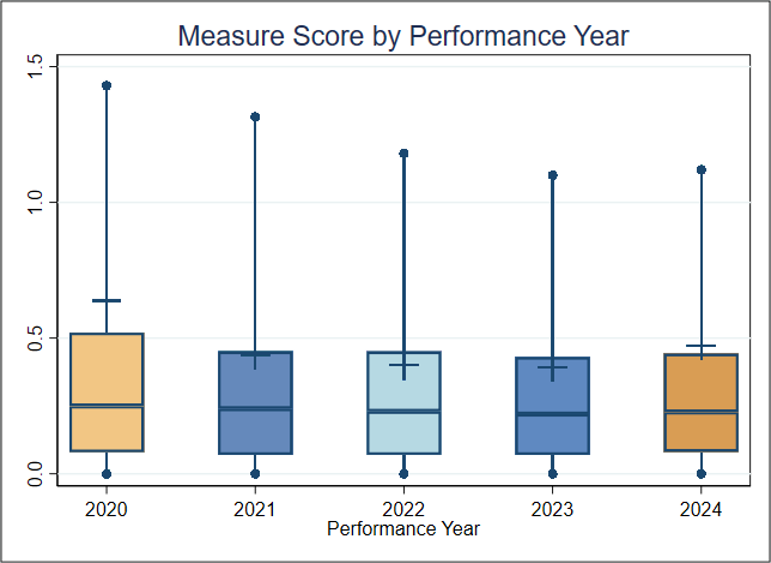
        Figure 1 (Measure Score by PY)
        boxplot


        Figure 1. Boxplot of Measure Score by Year

        Interpretation (Measure Score by PY)

        Figure 1 Interpretation: This figure shows negligible change in median score over the last 5 years, although the highest 5% of the scores decreased from 1.4% or greater in 2020 to about 1.1% or greater in 2023-2024. For this measure, a lower score indicates better quality of care.

        About this Analysis (Score Distro)

        About Table 1: Table 1 illustrates the distribution of scores across deciles for the most recent year of data available.

        Table 1 (Score Distro)

         Table 1. Importance (Decile by Measure Score, 2024) 

         OverallDecile 1Decile 2Decile 3Decile 4Decile 5Decile 6Decile 7Decile 8Decile 9Decile 10
        Average Score (Standard Deviation)0.47 (3.52)00.010.080.130.190.260.340.450.632.62
        Entities 1,640164164164164164164164164164164
        Interpretation (Score Distro)

        Table 1 Interpretation: Nearly 20% of the entities have a score at or near 0%, and about 80% have a score less than 0.5%. If the average performance of Decile 3 (0.8%) is considered a plausible, achievable score, and the entities in Deciles 4 through 10 improved to reach that score, the estimated rate of patients with an unplanned anterior vitrectomy could decrease from about 0.5% to about 0.07%, potentially leading to better health outcomes.

          Importance Criterion Definition

          The Meaningfulness criterion will be evaluated as part of the full Preliminary Assessment available in September. 

            Criterion Definition

            This criterion will be evaluated as part of the full Preliminary Assessment available in September. 

              Criterion Definition

              This criterion will be evaluated as part of the full Preliminary Assessment available in September. 

              PA Type
              Performance and Impact Analysis (PIA)