
Breadcrumb

  1. Home

Home Health

PRMR Measure Valid
On
Valid for Measure Submission

CAHPS® Home Health Care Survey Care of Patients

The updated Consumer Assessment of Healthcare Providers and Systems® (CAHPS) Home Health Care Survey, also referred as “HHCAHPS,” is a 25-item instrument. This is a standardized survey instrument and data collection methodology for measuring home health patients’ perspectives on their home health care in Medicare-certified home health care agencies. The survey is administered monthly to patients who recently received or are receiving home health care from Medicare-certified home health agencies. It is offered as mail-only, phone-only or mixed mode (mail with telephone follow-up).

CBE ID
0517-1

CAHPS® Home Health Care Survey Communications Between Providers and Patients

The updated Consumer Assessment of Healthcare Providers and Systems® (CAHPS) Home Health Care Survey, also referred as “HHCAHPS,” is a 25-item instrument. This is a standardized survey instrument and data collection methodology for measuring home health patients’ perspectives on their home health care in Medicare-certified home health care agencies. The survey is administered monthly to patients who recently received or are receiving home health care from Medicare-certified home health agencies. It is offered as mail-only, phone-only or mixed mode (mail with telephone follow-up).

CBE ID
0517-2

CAHPS® Home Health Care Survey Review Medicines

The updated Consumer Assessment of Healthcare Providers and Systems® (CAHPS) Home Health Care Survey, also referred as “HHCAHPS,” is a 25-item instrument. This is a standardized survey instrument and data collection methodology for measuring home health patients’ perspectives on their home health care in Medicare-certified home health care agencies. The survey is administered monthly to patients who recently received or are receiving home health care from Medicare-certified home health agencies. It is offered as mail-only, phone-only or mixed mode (mail with telephone follow-up).

CBE ID
0517-3

CAHPS® Home Health Care Survey Talk About Home Safety

The updated Consumer Assessment of Healthcare Providers and Systems® (CAHPS) Home Health Care Survey, also referred as “HHCAHPS,” is a 25-item instrument. This is a standardized survey instrument and data collection methodology for measuring home health patients’ perspectives on their home health care in Medicare-certified home health care agencies. The survey is administered monthly to patients who recently received or are receiving home health care from Medicare-certified home health agencies. It is offered as mail-only, phone-only or mixed mode (mail with telephone follow-up).

CBE ID
0517-4

CAHPS® Home Health Care Survey Talk About Medicine Side Effects

The updated Consumer Assessment of Healthcare Providers and Systems® (CAHPS) Home Health Care Survey, also referred as “HHCAHPS,” is a 25-item instrument. This is a standardized survey instrument and data collection methodology for measuring home health patients’ perspectives on their home health care in Medicare-certified home health care agencies. The survey is administered monthly to patients who recently received or are receiving home health care from Medicare-certified home health agencies. It is offered as mail-only, phone-only or mixed mode (mail with telephone follow-up).

CBE ID
0517-5

Cross-Setting Discharge Function Score – for Home Health Agencies

This outcome measure estimates the percentage of Home Health (HH) Medicare patients (18+) who meet or exceed an expected discharge function score over a 12-month period.

The expected discharge function score is a risk-adjusted estimate that accounts for patient characteristics.

CBE ID
4645

Documentation of Current Medications in the Medical Record

CMS Measures Inventory Tool (CMIT) ID
00219-01-C-MIPS
Steward Organization Group
Centers for Medicare & Medicaid Services (CMS)
Committee
MSR Recommendation Group
    Measure Overview
      Use in CMS Programs
      CMS Program History
      • Finalized through rulemaking for inclusion in the Merit-based Incentive Payment System (MIPS) in 2016.
      • Implemented in MIPS starting with Performance Year (PY) 2017.
      Description

      Percentage of visits for which the eligible clinician attests to documenting a list of current medications using all immediate resources available on the date of the encounter.

      Numerator

      Eligible clinician attests to documenting, updating, or reviewing the patient's current medications using all immediate resources available on the date of the encounter.

      Numerator Exclusions

      N/A

      Numerator Exceptions

      N/A

      Denominator

      All visits occurring during the 12-month performance period.

      Denominator Exclusions

      None

      Denominator Exceptions

      N/A

      Cascade of Meaningful Measures Priority
      Measure Type
      Process
      Level of Analysis
      Clinician: Group/Practice
      Clinician: Individual
      Care Setting
      Ambulatory Care: Clinician Office
      Behavioral Health: Inpatient (e.g., Inpatient Psychiatric Facility)
      Dialysis Facility
      Home Health
      Hospital: Outpatient
      Inpatient Rehabilitation Facility
      Nursing Home/Skilled Nursing Facility
      CBE Endorsement Status
      Not Endorsed
      CBE Endorsement History

      While this clinical quality measure (CQM) has not undergone consensus-based entity (CBE) endorsement, the electronic clinical quality measure (eCQM) collection type for this measure has gone through the CBE process and is outlined below. 

      • Initial endorsement, 2008
      • Measure retired and endorsement removed, Patient Safety, Spring Cycle 2020

      Link to endorsement measure record: Documentation of Current Medications in the Medical Record

        About this Analysis (Measure Score by PY)

        Impact Summary: This measure supports the Merit-based Incentive Payment System (MIPS) goals of improving the quality and safety of care for patients and promoting higher-value care by ensuring clinicians document a current and complete medication list at each visit, which supports accurate clinical decision-making and helps reduce preventable medication errors and adverse drug events. 

        Clinician performance has consistently increased from 2021 to 2024, but highlighted improvement is needed among lower-performing clinicians. The analysis showed that a medication documentation rate of 100% is achievable. Based on the PY 2024 data, only 7.7% of the assessed visits lacked documentation of medications. While performance for this measure in MIPS continues to be high, there continues to be instances of poor performance as seen by Decile 1: 3.65 - 78.37.

        For this measure, Battelle reviewed the following publicly available datasets at Benchmarks - QPP:

        • 2026 MIPS Quality Benchmarks.csv (which is referred to as year 2024 in this assessment)
        • 2025 MIPS Quality Benchmarks.csv (which is referred to as year 2023 in this assessment)
        • 2024 MIPS Quality Benchmarks.csv (which is referred to as year 2022 in this assessment)
        • 2023 MIPS Quality Benchmarks.csv (which is referred to as year 2021 in this assessment)

        Battelle analyzed benchmark values for “Measure_ID”=130 and “CMS eCQM ID”=N/A to generate CQM benchmark data.


        About Figure 1: Figure 1 is a boxplot that shows how rates have changed based on the most recent 4 years of data available. For each year, the boxplot displays a box with lines and dots to help visualize the range and distribution of rates. The dots represent the minimum and maximum rates, and the line connecting them shows the range of the rates. The box itself covers the middle 60% of the rates, from the 20th to the 80th percentile. A “+” sign shows the average rate. This type of graph makes overall trends in rates over time as well as the consistency and spread of the results easier to visualize.

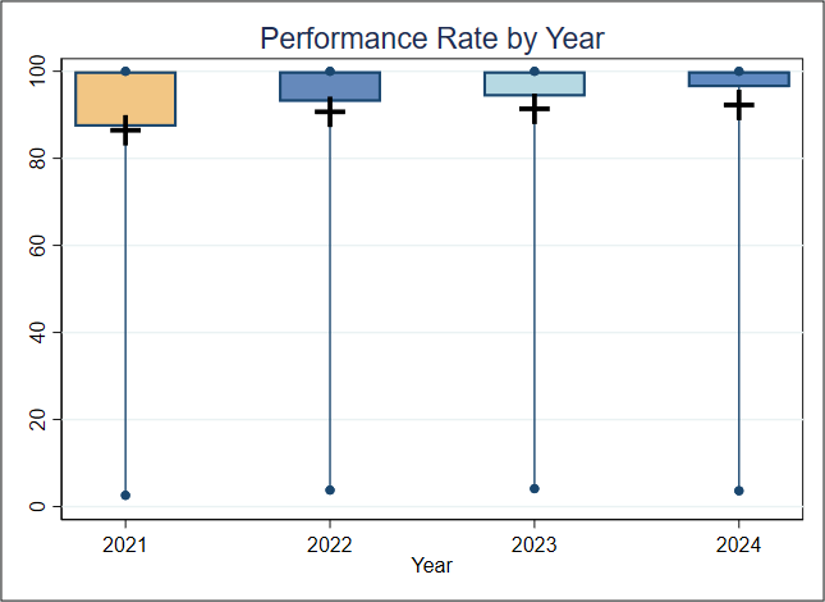
        Figure 1 (Measure Score by PY)
        boxplot

        Figure 1. Boxplot of Performance Rate by Year

        Interpretation (Measure Score by PY)

        Figure 1 Interpretation: Although each year there are some clinicians with very low performance, the 20th percentile has consistently increased from 87.26% in 2021 to 96.34% in 2024. For this measure, a higher rate indicates better quality of care. 


        About this Analysis (Score Distro)

        About Table 1: Table 1 illustrates the distribution of rates across deciles for the most recent year with data available. 

        Table 1 (Score Distro)

        Table 1. Importance (Decile by Performance Rate, 2024) 

         MeanDecile 1Decile 2Decile 3Decile 4Decile 5Decile 6Decile 7Decile 8Decile 9Decile 10
        Performance Rate

        92.3

        3.7-78.4

        78.4-96.3

        96.3-99.5

        99.5-100

        100

        100

        100

        100

        100

        100


        Interpretation (Score Distro)

        Table 1 Interpretation: More than 80% of clinicians have a performance rate greater than 95%, and more than 60% of clinicians have a rate of 100%. If Decile 8 performance (100%) is used as a plausible, achievable benchmark, and clinicians in Deciles 1 through 4 improved to that level, the estimated percentage of visits with current medications documented in the medical record would increase by about 7.7% (from 92.3% to 100%), potentially leading to better health outcomes for patients.

          Importance Criterion Definition

          The Meaningfulness criterion will be evaluated as part of the full Preliminary Assessment available in September.  

            Criterion Definition

            This criterion will be evaluated as part of the full Preliminary Assessment available in September. 

              Criterion Definition

              This criterion will be evaluated as part of the full Preliminary Assessment available in September. 

              PA Type
              Performance and Impact Analysis (PIA)

              Falls: Screening for Future Fall Risk

              CMS Measures Inventory Tool (CMIT) ID
              00257-02-E-MIPS
              Steward Organization Group
              National Committee for Quality Assurance (NCQA)
              Committee
              MSR Recommendation Group
                Measure Overview
                  Use in CMS Programs
                  CMS Program History
                  • Finalized through rulemaking for inclusion in the Merit-based Incentive Payment System (MIPS) in 2016.
                  • Implemented in MIPS starting with Performance Year (PY) 2017.
                  Description

                  Percentage of patients 65 years of age and older who were screened for future fall risk during the measurement period.

                  Numerator

                  Patients who were screened for future fall risk at least once within the measurement period.

                  Numerator Exclusions

                  N/A

                  Numerator Exceptions

                  N/A

                  Denominator

                  Patients aged 65 years and older at the start of the measurement period with a visit during the measurement period.

                  Denominator Exclusions

                  Exclude patients who are in hospice care for any part of the measurement period.

                  Denominator Exceptions

                  N/A

                  Cascade of Meaningful Measures Priority
                  Measure Type
                  Process
                  Level of Analysis
                  Clinician: Group/Practice
                  Clinician: Individual
                  Care Setting
                  Hospital: Inpatient Acute Care Facility
                  Ambulatory Care: Clinician Office
                  Home Health
                  Hospital: Outpatient
                  Nursing Home/Skilled Nursing Facility
                  CBE Endorsement Status
                  Not Endorsed
                  CBE Endorsement History

                  N/A

                    About this Analysis (Measure Score by PY)

                    Impact Summary: This measure supports the Merit-based Incentive Payment System (MIPS) goals of improving the quality and safety of care for patients and promoting higher‑value care by identifying patients at risk for falls and applying preventative measures. 

                    Clinician performance increased from 2021 to 2024 showing overall improvement; however, the rates were spread evenly across the entire range each year, highlighting the variation in performance each year among reporting clinicians. The analysis suggests that a rate of 98% is achievable relative to the 2024 rate of 67.3%, suggesting a gap in care of about 30%.

                    For this measure, Battelle reviewed the following publicly available datasets at Benchmarks - QPP:

                    • 2026 MIPS Quality Benchmarks.csv (referred to as year 2024 in this assessment)
                    • 2025 MIPS Quality Benchmarks.csv (referred to as year 2023 in this assessment)
                    • 2024 MIPS Quality Benchmarks.csv (referred to as year 2022 in this assessment)
                    • 2023 MIPS Quality Benchmarks.csv (referred to as year 2021 in this assessment)

                    Battelle analyzed benchmark values for “Measure_ID”=318.


                    About Figure 1: Figure 1 is a boxplot that shows how rates have changed based on the most recent 4 years of data available. For each year, the boxplot displays a box with lines and dots to help visualize the range and distribution of rates. The dots represent the minimum and maximum rates, and the line connecting them shows the range of the rates. The box itself covers the middle 60% of the rates, from the 20th to the 80th percentile. A “+” sign shows the average rate. This type of graph makes overall trends in rates over time as well as the consistency and spread of the results easier to visualize.
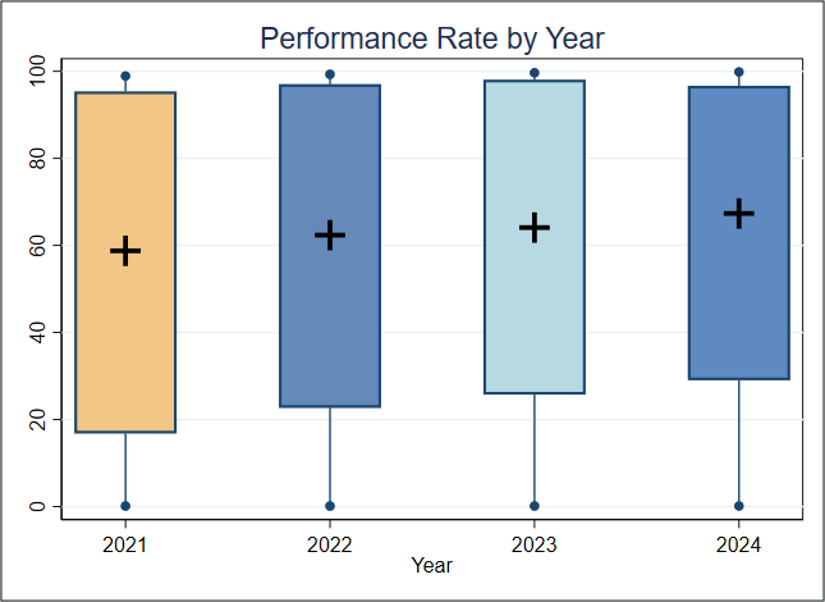
                    Figure 1 (Measure Score by PY)
                    boxplot

                    Figure 1. Boxplot of Performance Rate by Year

                    Interpretation (Measure Score by PY)

                    Figure 1 Interpretation: The rates are spread evenly across the entire range of 0 to 100%. The mean rate increased from 58.76% in 2021 to 67.34% in 2024. The wide spread of performance rates indicates that there is still much variation across clinicians. For this measure, a higher rate indicates better quality of care.

                    About this Analysis (Score Distro)

                    About Table 1: Table 1 illustrates the distribution of rates across deciles for the most recent year of data available.

                    Table 1 (Score Distro)

                    Table 1. Importance (Decile by Performance Rate, 2024) 


                    Mean

                    Decile 1

                    Decile 2

                    Decile 3

                    Decile 4

                    Decile 5

                    Decile 6

                    Decile 7

                    Decile 8

                    Decile 9

                    Decile 10

                    Rate

                    67.3

                    0.2-7.9

                    7.9-29.0

                    29.0-50.5

                    50.5-68.0

                    68.0-81.6

                    81.6-90.9

                    90.9-96.7

                    96.7-99.0

                    99.1-99.9

                    99.9-100


                    Interpretation (Score Distro)

                    Table 1 Interpretation: More than 20% of the clinicians have a rate less than 30%, and more than 40% of the clinicians have a rate greater than 90%. If the average performance of Decile 8 (about 98%) is considered a plausible, achievable rate, indicating a performance gap of about 30% (from 67.3% to 98%).

                      Importance Criterion Definition

                      The Meaningfulness criterion will be evaluated as part of the full Preliminary Assessment available in September.  

                        Criterion Definition

                        This criterion will be evaluated as part of the full Preliminary Assessment available in September. 

                          Criterion Definition

                          This criterion will be evaluated as part of the full Preliminary Assessment available in September. 

                          PA Type
                          Performance and Impact Analysis (PIA)

                          Home Health Care CAHPS Survey (HHCAHPS)

                          The updated Consumer Assessment of Healthcare Providers and Systems® (CAHPS) Home Health Care Survey, also referred as “HHCAHPS,” is a 25-item instrument. This is a standardized survey instrument and data collection methodology for measuring home health patients’ perspectives on their home health care in Medicare-certified home health care agencies. The survey is administered monthly to patients who recently received or are receiving home health care from Medicare-certified home health agencies. It is offered as mail-only, phone-only or mixed mode (mail with telephone follow-up).

                          CBE ID
                          0517

                          Improvement in Ambulation/locomotion

                          Percentage of home health episodes of care during which the patient improved in ability to ambulate. This is a rate/proportion measure targeted at older adults with multiple chronic conditions during home health quality of care episodes. 

                          CBE ID
                          0167